21/181

The return of the cold water bath has meant a lot of shower thinking time.

Nothing can compare to the feeling of cold water hitting your skin at 8AM when you’re groggy and it’s humid/cold outside. You would’ve sweat through the night, and you really need 8 more hours of sleep, yet, here you are, awake and pretending to be in your senses while you mindlessly brush your teeth.

Someone’s playing a song in the stall and you’re trying to understand how on Earth someone can be so bubbly so early in the morning.

On your way in, people are walking out – which is amazing considering you did attendance calculations to figure out whether to wake up at all.

And then you turn on the hot water tap. With what hope, what prayer, nobody knows. Yet, you turn it on, hoping for a clear stream with some steam. You turn it around more when no water arrives, hoping a water pressure issue means that the tap only functions when it’s fully on. No luck.

So you sigh, and yell at the void: “Garam paani hai kya?”

And because you’re a senior now, people reply “Nahi”. One junior will say “Nahi sir” and you’ll tell him never to call you sir again.

He will call you sir that evening.

You will sigh.

And you’ll turn on the low-pressure, cold water tap. You’ll run your fingers through it at ten second intervals so it feels warmer each time. You’ll check your phone because the pressure’s so low, the bucket’s still filling up.

Then some hopeful will come searching for stalls. You’ll smile, knowing fully well that you’ve earned this stall – and that you aren’t exiting for another 10 minutes.

That’s when you’ll shut the door and begin bathing.

The real demon is your back, man. Everyone talks about how cold water can freeze your extremities, but it’s really just your back that’s tough to get through. Once your back adjusts, you’re fine and you almost start feeling warmth in the cold water.

Someone swears.

Clearly they’re new here.

You return to your room and change and head to classes.

The feeling of cold water remains etched in your memory, ready to revisit tomorrow.

The worst part is that you can experience the same cold daily, yet every day feels colder than the last. I’m looking for a Spotify playlist to help me get through this.

19/181

I’ve fallen in love with food shows again, just as I’ve started trying to exercise a little more in life. That should make things interesting, to say the least.

My mum and I have always shared an appreciation for food, and my dad’s enabled this love so much by being willing to try out new cuisines – so long as they are vegetarian. Literally, growing up, the only restriction I’ve had, diet wise, is “let it be vegetarian”. That naturally meant mum and I watched Masterchef thinking about whether we could use potato the same way they used different cuts of meat, but really, really looking forward to every single dessert challenge – because that’s really where we found recipes we could execute. Although, the only recipe I think we’ve ever tried is making tzatziki.

However my mother never enjoyed competitive eating challenges and shows that featured competitive eating, so Man v. Food was an absolute no-no.

How this ties back to everything I’ve typed out so far is that I’m binge-watching the latest Man v. Food season and seeing all this food makes me so happy.


18/181

Nothing will ever compare to the feeling of talking to your best friends.

A couple of things I’ve actively been working on over the past few months – especially since April is devoting time to the people I love, whether that’s my family, my friends, or even people I’ve met once that I’ve had a great time with. That means replying to things more frequently than I usually do, and trying to learn more from them.

Over the last two years, however, my best friends have been the ones who’ve been this pillar of support and understanding for the priorities I had set in my life at the time. They were people whom (as a result of time zones), I could call at 4AM in the morning and not get yelled at. People who’d give up sleep to talk to me.

I don’t know if I can ever show appreciation for the amount they’ve done to keep our friendship intact. Because that’s what relationships are based on – a lot of effort from both parties to one.

It’s pretty nice thinking about that.

17/181

I dislike thinking about the value that other people assign to me. Yet, it’s a thought that often crosses my mind. Does X find me interesting? Am I fun enough? Will everyone leave me?

Okay, jokes, not the last one.

But legitimately, while I drive away thoughts that assign self-worth based on public perception, it does end up happening sometimes. Especially when individuals I chat with pass judgment or act differently than they usually do.

Which begs the question: why do I expect a certain kind of behaviour from a certain individual?

Moreover: why does it bother me when people act differently?

I’ve identified that the root cause of this is that I consider myself way too important in people’s lives. Which means if someone is pissed, I am clearly the reason they are upset. If someone is happy, I am clearly the reason they are happy – or rather, I ought to be.

That kind of stuff is weird.

Realizing this has made me realize I need to take life a lot less seriously than I do. Which doesn’t mean reorganizing goals and whatnot. It’s just, the whole, perspective of everyone’s doing their own thing and everyone’s got a life of their own.

And that I need to stop thinking people are acting weird exclusively because of me.

I think this’ll also help me eliminate something I spoke about earlier: my inability to deal with unexpected news that takes away things I love.

A lot of that probably also comes from assigning value to your own time and your own sense of being.

As you can see, I’m caught in a spiral with this one, so I’m going to end this here.

Nothing like looking at you roommate sleeping to get you thinking, am I right?

Also wow! I just realized. Marriage, and having a partner is literally like having a roommate for the rest of your life.

How weird.

16/181

Today, I spent time thinking about why I started blogging. What magical thing went off in my brain and said “hey, you’ve got things to say, maybe people will read them! or maybe not, but you’ve got things to say, and you should say them anyway!”

The first blog I started was this formalized thing on blogspot my mother coerced me into. It was a thinly veiled attempt to explore my passion for English. Every post I put up was something I had crafted over a week of ideating, discussing with one of my parents, and then typing it out. Each post had a picture that it was uploaded with – the co-ordination I ended up doing was mindblowing to me at the time. There was a sense of pride with having your own URL. At that time, I was never into creative writing, so I ended up penning posts like “My Visit to Burj Khalifa”, which hahahah, come to think of it, even had this one line that said “AHHH IT WAS SO TALL”.

Looking back, I don’t think much has changed about why I write, or the style I write in. Much like Salman Khan treats his twitter, I treat you, my blog readers (if any) as people – and imagine that I’m narrating something incredibly boring to you all.

What got me writing the second time around was that I really wanted to have a voice at Law School. And the fact that I thought I was humourous – so I’d end up blogging these funny things that went viral and was the subject of memes. I actually ended up blogging from the library about night mess food a bunch of times, because I found it thoroughly fascinating.

Writing for me, however, has evolved now. It’s my only no-filter place. I often type things out on WhatsApp to people and backspace messages because I’m not entirely sure how they’ll respond to things. With this blog though, there’s no double-thinking. I type stuff out. If people respond, they will respond.

I’ll deal with it citing “editorial discretion” or some mumbo-jumbo of the sort I end up concocting.

Writing over the past year has ended up being cathartic. I can write about mundane things like my day, or take prompts and write things based on those. I can write things about friends without using their names, pen sentimental pieces of appreciation.

And then read them and reconnect the dots.

That’s what I love about where I am with my writing. I’m learning to relive things while enjoying what the present has for me.

And I’m trying hard not to overanalyze or overthink.


15/181

Being unwell sucks for a multiplicity of reasons. This post will chronicle my meeting with the cold-monster, the taker of my voice and the giver of sleep.

My first interaction with the cold monster this season happened a week ago.  He took away my voice instantly. Then he put me to sleep for 11 hours – I literally slept at 11:30 one night, which is super uncharacteristic of me.

Why being unwell sucks is because you end up hearing advice you’re already well aware of. Wear warm clothes, drink warm water, avoid sour things, avoid cold things, sleep a lot, try to attend classes even though you’re sick.

It’s frustrating – largely because you end up undermining your ability to take care of yourself. Questioning your ability to take care of your health is tough.

It makes you do things like begin to love green tea.

That’s what thinking can do. I’m literally drinking hot green tea as I type this – the stuff is amazing.

Also, it can recalibrate your taste buds so far, that you begin to dislike the taste of cold water – something that took you a whole semester to acquire.

Worse, it makes you hate sugar, and love honey.

I now possess, in my room, 2 squeezey honey bottles, and 3 boxes of green tea.

The other thing that annoys me about being unwell is that you feel really lethargic. Every part of your body wants to sleep, but you need to will yourself to get up and get things done.

Then there’s the weather.

It’s pretty bad.

The only silver lining is that you begin to appreciate things like health a lot more. And you consider making incremental changes to your lifestyle to be more “healthy”.

14/181

The problem with trying to do something everyday is that if you decide to skip things, you end up skipping things repeatedly, telling yourself you can get back to it tomorrow. This, ladies and gentlemen who find the time to read this blog, is known as procrastination, and it’s how I’ve found myself being 10 posts behind. The toughest part about this is that I’ve had to come up with 10 distinct ideas to reel off blogposts in one night. So, you’re in for quite the ride.

I personally think that’s the biggest problem with planning. You miss one thing and everything ends up going for a toss. Over the past couple of years, I’ve ended up relying on Google Keep to track the things I’m desirous of doing on a particular day. It’s a part of the daily routine – get up, bathe, take 5 minutes to figure out how I plan to spend my day.

And then end up getting sidetracked by something or the other and incorrectly prioritizing things.

I think that’s the hardest/most annoying thing about planning daily life. Something always ends up getting added and it’s really difficult to finish stuff that you want to and manage a solid sleep cycle.

Probably will reconsider the whole planning thing at some point. But that isn’t for now. Keep, in fact, is what has helped me figure out I was 10 posts behind.


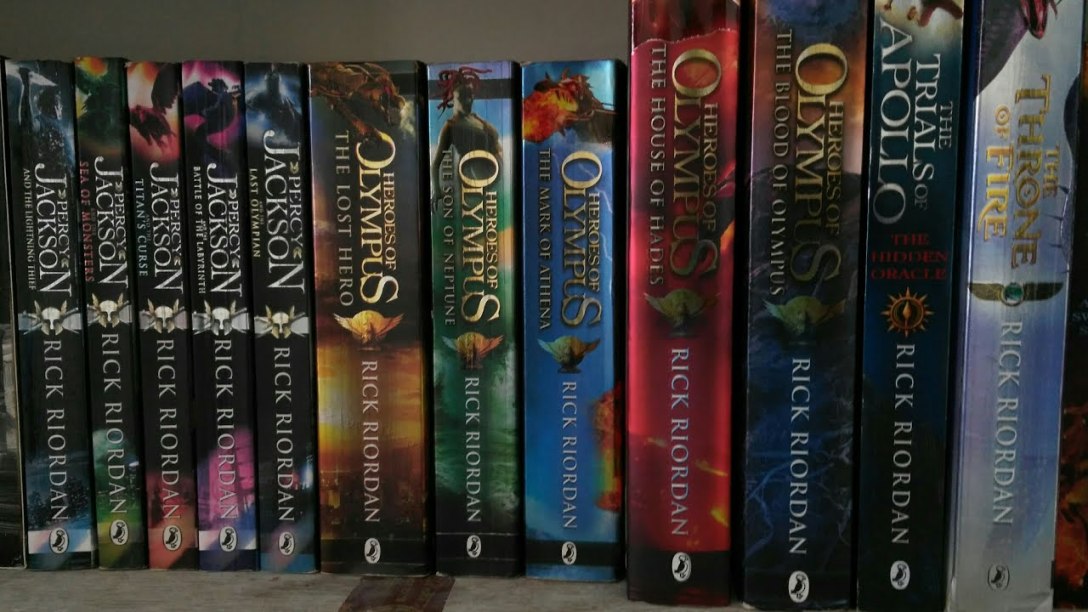
Rediscovering: Rick Riordan

This is the first of my posts in the Rediscovering series, where my focus will be on reviewing works of authors whom I stopped following as my reading list began to expand. My method of doing this will be fairly simple – I’ll be taking a week to read through major work an author I have previously enjoyed has written, excluding the books I can remember in their entirety. This will mean a lot of reading, but I believe it’ll be a fun little project to have ongoing. Additionally, it’ll help me catch up on a lot of authors I’ve missed out due to my ignorance – which is what I’m looking forward to the most.

As an avid fan of mythology and someone who loves learning History, I thought it would be best if I started this off with Rick Riordan. Here’s what I read over the course of the week (bear in mind, these books are written in a super enjoyable style – so you can go cover-to-cover in a sitting.):

1. The Lost Hero (The Heroes of Olympus #1): ***
2. The Son of Neptune (The Heroes of Olympus #2): ****
3. The Mark of Athena (The Heroes of Olympus #3): *****
4. The House of Hades (The Heroes of Olympus #4): *****
5. The Blood of Olympus (The Heroes of Olympus #5): ***
6. The Hidden Oracle (The Trials of Apollo #1): ****
7. The Dark Prophecy (The Trials of Apollo #2): ***
8. The Burning Maze (The Trials of Apollo #3): **** 

Clearly, a bunch of Riordan reading has taken place. Prior to this, I had read the Percy Jackson and the Olympians series, and a bit of the Kane Chronicles series, in addition to add-on books Riordan had published. Further, I’m a huge fan of the 39 Clues series – so it was really lovely to read the books he had authored there.

This piece will focus on highlights of Riordan’s writing, as well as critical comments on what I think makes his books difficult to read. I’ll divide this up into a couple of parts so it’s easier to structure and follow.

Plot

It is extremely difficult to read books that don’t have plots. While I hugely respect individuals who are able to write an entire novel and put it up for the world to critique, I, personally find it very challenging to read fictional published work that doesn’t have progression of a plot. It gets way worse when an author announces that the book is a part of a series – because there needs to be a grander narrative at play to keep me engaged. Considering I read two Riordan series  back-to-back, I was initially quite skeptical that I would be hooked throughout the week. At various points, I was quite certain that I would be disengaged. Yet, Riordan managed to draw me in. Here’s what I admire the most about his work. If you’ve read the Percy Jackson series, you’ll be able to relate to this really well. Aside from the individual narratives at play within each book – with quests, and Percy making friends/enemies in the demi(God) world in the process, there’s a grander plot narrative of Camp Half-Blood and it’s struggle in the wake of continuous crises that it faces. Moreover, there’s constant plot progression with new sub-arcs being introduced, and fresh characters being fleshed out – at just the right places. It’s what makes you want to read further. Especially if you’re a fan of mythology – because prior to the release of the next book, all you can think about is which Greek/Roman God will you be seeing next? And why? That element of engagement is crucial.

Riordan carries that forward to both of these series’ with ease. The plot of each book is varied (which for me, marks out why some have 3 stars and some have 4), but the series, viewed has a whole, has a consistent plot progression which I thoroughly enjoyed. There’s this supreme back and forth taking place between Camp Half-Blood and Camp Jupiter, and the tension, and ultimate camaraderie between the protagonist of each Camp (technically speaking), keeps you hooked as you move from one book to the next.

Plot-wise, the Trials of Apollo seem to be something Riordan put in more effort into. With The Heroes of Olympus, the ability to switch between characters’ voices makes it easier to develop plot – because you’re able to continue the narrative/repeat a sequence of events from a different voice. Since the Trials of Apollo focus exclusively on Apollo, it seems to have had more nuance to it, which took me back to the Percy Jackson days.

All in all, what I appreciate the most is that Riordan seems to have things planned out before starting a series. I do believe there is comfort a reader has when they know exactly how many books a series will contain (I feel this way), and that assurance hits it peak with authors like Riordan, who appear to have a map of exactly how things will play out, and seem to fit in ideas they have later, almost casually as subplots within a grander scheme.

Character and Character Development

While having strong characters aids plot development greatly, I do believe this aspect of Riordan’s writing is what draws him the most amount of praise. The demographic that reads Riordan’s books are a part of the age group that is the most impressionable. The values they learn essentially guide an entire generation. The world is a cruel place, and there’s a lot of discrimination that several individuals are trying to ward off and eliminate. Riordan does it by introducing characters who have the broadest spectrum of interests I have ever seen in a fictional piece, with the broadest origin stories (in terms of ethnicity). The “identity” of a character in a Rick Riordan book is not marked out by their appearance (although that helps with the aesthetic and the fanart), or their sexuality (although Riordan does ignore one part of the sexual spectrum), or gender – there’s a lot of emphasis on the virtues that make up a person.

This is not to make him sound like the Ubermensch of the writing art. What I love about Riordan’s work is that when characters bully/discriminate against other characters, there’s a lot of positive reinforcement about the unique worth of an individual. Whether this is done in the form of  a “God’s” speech, or in the form of a romantic arc, or even in the form of friends who support someone – there’s always this constant belief that each person in the book adds value to the book itself. Which is exactly what the real world works like. I know this sounds supremely profound, but it’s true. It’s also one thing I believe Riordan has done better than Rowling – planned out characters instead of labeling their attributes post-publication.

That’s one part. The other thing Riordan does really well is give each character a sense of purpose and a bit of development. Right from the Percy Jackson and the Olympians series, there have been characters who fade in an out at pivotal points in the Universe to move Percy (who I still consider a protagonist) forward. Whether this is Grover, who appears at various points in the Heroes of Olympus sequence, or even Leo (who ends up fading out and returning), I think Riordan does a great job of phasing in characters and giving us a break from one perspective to learn more about everyone else.

By shifting across points of view, Riordan is also able to give each character a unique voice. You’re able to get an almost cinematic view of what is happening – from three/four angles at any given point of time. Each character has their own priorities, their own struggles, their own perspective to every hurdle thrown at them. That’s pretty cool.

Lastly, what Riordan does with each character – by adapting them to modern times, is just outstanding. To give each God a persona that is in line with what we know most commonly about them (so they’re relatable), yet, a persona that dignifies their stature in history (so they’re accurate), takes a lot of research and deserves credence. Midas (who has a “golden” touch) is a great exemplar – I’ll elaborate on this a little more in the next section.

However, my biggest grouse with Riordan was how the Heroes of Olympus series ended. If I was following the series intently, I do believe I would have developed a strong bond with Percy and Annabeth – who seem to have survived the worst of most quests in the books and, literally, survived, the longest. The screentime they receive in Blood of Olympus, both individually, and together, is a little tragic – I think there was a little more to extract out of them.

There are still books to come, so I’m eager to see whether they return in starring roles (Percy has) at a later stage.

The Universe

A critical aspect of any memorable series is the Universe it creates. Its why I loved the Three Body Problem so much. Rick Riordan tries to make history more grasp-able so-to-speak. By adapting really old, sentinel-esque figures of the Roman and Greek tales into the common, modern, accessible world, Riordan creates a Universe where normal human beings interact with superior powers, separated from them by The Mist. He’s able to inject aspects of everyday life – such as telephone calling and modern clothing, in addition to corporations we interact with, like Amazon into a plot that’s filled with historical detail. Further, what I think makes him stand out is that he creates a visual representation of what this world looks like by mapping it directly onto cities within the United States of America.

By locating the entrance to Olympus, the Oracle of Delphi, and several other Greco-Roman pieces within the broad framework of the United States of America map, Riordan is able to inject cultural nuances into the persona of each demi(God) – and to help Camp Half-Blood come to life.

As someone whose American geography is terrible, I ignored these aspects, but once I finished the series, the breadth of their travels, and the amount of detail Riordan plays to elements like seasonal weather, and accents, and dressing sense is quite admirable. It creates character relatability as well, which helps the series endure.

Dialogue

There’s an ease with which Riordan creates deep, meaningful dialogue, and manages to intersperse it with a lot of humor. Personally, I think this mimics everyday life the most. My problem with John Green is that the way his characters talk is not what people of his characters age really sound like. That’s not an issue I face with Riordan. His characters act their age – some more mature than others, but they all sound like what people of their age would ordinarily sound like. They’re the kind of people I wouldn’t mind hanging out with over lunch, versus Green’s characters, who I’m more likely to engage in conversation with at 2AM, when I’m feeling super philosophical.

The dialogue Riordan uses also adds to the voice of each character. Through subtle grammatical features – like an ellipsis, or longer, winding sentences, you’re able to identify yourself with the voice of each character. I heard an audiobook version of The Son of Neptune after I finished the book – and the narrator of the version I heard did a phenomenal job of recognizing the subtleties of each voice and bringing it to life. It’s what I think makes casting a Riordan movie really tough – you’ll have to find people who sound distinct – which is a challenge in today’s industry.

If you want a glimpse into what I mean by the power of Riordan’s dialogue, here are samples:

A. Leo’s response

“I’m the son of Jupiter, I’m a child of Rome, consul to demigods, praetor of the First Legion. I slew the Trojan sea monster, I toppled the black throne of Kronos, and destroyed Titan Krios with my own hand. And now I’m going to destroy you Porphyrion, and feed you to your own wolves.”
“Wow, dude,” Leo muttered, “You been eating red meat?” 

B.  Percy

“Reyna sent me to get Percy,” Frank said. “Did Octavian accept you?”
“Yeah,” Percy said. “He slaughtered my panda.”

C. The pun with “lairs”

“They’re Lares. House gods.”
“House gods,” Percy said. “Like…smaller than real gods, but larger than apartment gods?” 

D. The Identity Crisis

“You’re that lady,” Leo said. “The one who was named after Caribbean music.”
Her eyes glinted murderously. “Caribbean music.”
“Yeah. Reggae?” Leo shook his head. “Merengue? Hold on, I’ll get it.”
He snapped his fingers. “Calypso!”

E. The use of Noob

“Akhlys lunged at Percy, and for a split second he thought: Well, hey, I’m just smoke. She can’t touch me, right?
He imagined the Fates up in Olympus, laughing at his wishful thinking: LOL, NOOB!” 

Takeaways

Young adult writing is not just for kids. I think it’s worth appreciating how these works can also be viewed as literary masterpieces, because that’s what they are, sometimes. Additionally, they often provide as forays into bits and pieces of culture, and history – which is what I think Riordan is very, very successful in doing.

While assessing Riordan’s work, the New Yorker presents a piece called “The Percy Jackson Problem”, which I personally think is just a descriptive essay about a debate that has long been going on – should we be worried about what kids read? Is all reading good? I think that’s something worth considering and formulating your own opinion on. For me, at that age, inculcating a reading habit was important – and I don’t think it’s necessary to enforce genre-specific reading on everyone. People can choose to embrace young adult literature for the entirety of their lives – that doesn’t make them any less a “reader” than you are.

Lastly, I think Riordan ought to be appreciated for the sheer volume he writes. It’s almost as if he publishes a book a year – which is astounding pace for anyone. Especially considering he’s writing upward of 500 pages for each book.

All-in-all, I’ve had a pretty great week. I’d recommend all of Riordan’s books that I’ve read to you, barring the Kane Chronicles.

Let me know what you think of this series – I’m hoping to continue it atleast once a month.

Cheers!

13/181

I’ve woken up in the middle of the night to write.

I literally just woke up with this one question in my head, and I was staring at 3 red dots – because my extension cable/surge protector has these indicator lights, and they were super-duper blurry. So naturally I swatted at them.

The lights did not disappear, but my brain did wake up properly.

Coming back to what made me get up.

Do you ever wonder how it is we came to a position where you need to figure out who you’re not before you figure out who you are? Like, over the course of the years I have spent figuring out my likes and my dislikes, it’s happened over time in such a way that I’ve had to figure out that I naturally dislike things that maybe some others might like. And that just because others like a particular thing, that doesn’t mean I need to like it too.

Society sort of puts pressure on you to behave a certain way, or have a certain type. And it’s super weird, but this mentality forces you to figure out the kind of person you never want to become. Which ultimately helps you figure out the kind of person you want to be, and how you can get there.

As I type this, I realize these thoughts are not supremely profound.

For example, it is completely possible for someone to figure out who they are by finding the characteristics in other individuals that they enjoy seeing, or the characteristics of another individual that they can relate to.

My thoughts at 2AM in the morning are wildly incoherent.

Much like my brain. Which coerced my hand into swatting at indicator lights in the darkness.

I will return to my slumber. Class starts late tomorrow morning. GNLU sometimes gives you the best surprises.


12/181

If there’s one thing I can say with absolute certainty, it’s that when weather changes roll around, I will fall ill. I even tried Chywanprash – regularly, that too, last year. But that hasn’t seemed to creep it’s way into strengthening my immunity.

One July/August day, you guys, I will be unafflicted by a throatache that burns the inner linings and makes my voice deeper than the regular deep, and my screams hit the pitch of a cow mooing while running away.

There are stages of colds, y’know? You can describe these stages as runny, solid, one nostril clear, and both clear. Your breath, ordinarily at the temperature of the air around you, goes from cold, to HOT, to matching the temperature of the air around you, and that’s when you know you’re okay.

I, however, describe the stages of being unwell based on the clothing I wear. There’s “normal”, which is when I’m not yet affected, to the point that I start feeling a small throat itch, to “okay lazy shorts” to where I need to be in super comfortable shorts and an oversized t-shirt, to “time for PJs” because there is nothing else that can make you feel warm.

But, this is Gujarat. Hence, this evening, when my cold hit peak PJ time, I had a very important decision to make. Do I choose to subject my body to Gujarat humidity and wear PJs where I sweat through the night? Or do I wear comfy shorts?

I have ended up, friends, wearing a shirt I can proudly snot on without worry and PJs which are so comfortable, you will wish you had an overall of this kind.

If you ever come across checked patterns on male pyjamas, you should feel the fabric. Oh wow, the fabric of these checked patterned clothes, man. Gentle to the skin, and elastic on the waist. Man, that’s a double whammy.

Added to this, I have discovered a new show I might be borderline hooked on to.

AND, I have moved my bed to the wall.

Will I wake up for class tomorrow?

Tune in to find out.