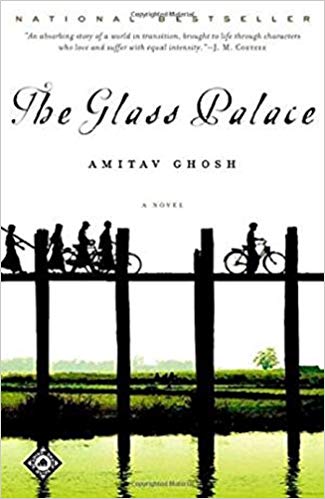
The Glass Palace | Amitav Ghosh

The Glass Palace
by Amitav Ghosh
Published by Random House Trade Paperbacks (2002)
Rating: ****

So many notable events occur around us on a daily basis. This makes the recording of news a difficult task. How do you select what is relevant and what is not, how do you choose what to report, and what to leave out? It’s also what makes the study and recording of History such a vast task. Human history has not been kind to historiographers. Nor has it been kind to authors of historical fiction. Ghosh, however, makes writing and living through a century an easy feat. In this accomplishment lies his greatest feat.

The Glass Palace is a fascinating account that takes place across borders. Politically, it reflects happenings in Burma and India around when Burma becomes colonized, and fascinatingly enough, the roots of an independence movement begin to develop in India. Economically, it looks at, and analyzes the impact of the discovery of teak and rubber as important trade items in Asia – the impact it has on individuals possessing these resources, and the broader societal structures relying on these individuals. On the whole, it’s perhaps the best novel I’ve read that focuses exclusively on the impact of colonialism on a lower-middle class society, incorporating the upper classes interactions with them.

The novel begins in Burma – focusing on a young kalaa (we later learn he is Indian) without a home, without parents. It introduces us to Rajkumar, and through the eyes of youth, describes the conduct of the Burmese Royals. Set in their ways, with several oddities. A short while later, Ghosh shifts perspective to focus on the Royals, and explains their history in brief. The shift in tone is evident, but not abrupt, and the pace of writing quickens through this passage to allow for a build-up to the exit of the Royals from India.

It is here that Rajkumar meets his Rani. An encounter with the Queen also leads to Rajkumar meeting Dolly – who he believes to be the most beautiful woman he has ever met. Their chance encounter appear to be the first of only two. They are separated, rather quickly, and the destruction the British Empire metes out is evident, rampant, and Rajkumar is also soon separated from his adoptive family, Ma Cho.

A significant accomplishment of Ghosh is how he interweaves the latter parts of Rajkumar’s and Dolly’s life. Living in completely different continents, Ghosh is able to use language effectively to sift through settings with ease. The vivid detail allows you to transition between what feels like two different novels with no real discomfort, and continuous plot progression.

The latter parts of the book highlight the inertia with Indian independence struggle at its initial phases, told through the relationship of a woman who connects Rajkumar and Dolly with the country. As a post-colonial read, the book is a fantastic account of history, told through an ever-expanding, but connected set of leading characters.

However, at points, events take place with an absurdness and staccato which is uncomfortable. People falling in love, people becoming best friends – these are events and feelings which develop over time, and Ghosh attempts to circumvent the process of describing his characters’ interactions by using a deadpan “X and Y became fast friends” in its absence. Understandably, a limitation of historical fiction is that a lot of words are spent on historical detail, but words are necessary at times to describe slowly developing feelings.

On the whole, an enjoyable read from an Indian-born author – a great start to 2019.

2019: Ten

I’m incredibly attached to the electronic devices I am fortunate to own. Very high levels of attachment. To be honest, I’ve always loved gadgets and technology. There are two stores I can spend all day in, without any company: electronics stores, and sports equipment stores. I’ve done this on numerous occassions, so I speak from a position of experience.

Each time I choose to purchase a new electronic gadget, there is both reason (it’s never random expenditure), and research. So, for example, a new laptop is purchased only if the old laptop is beyond all repair and use. And time is devoted to research. Before purchasing my first laptop for me (as a nice surprise), my father made me visit electronic shops and speak to technicians. I didn’t like the idea at the time – I remember deciding really early that I would only spend half the day looking at laptops, but spend the other half loafing around the mall to eat good food, and then get back to the PS4 installation at the shop at play FIFA.

I was honestly pretty surprised at how much time it actually took to research electronics. But reflecting on that experience, that laptop I researched on gave me 5.5 really solid years – and 3 sets of board exams. I used it so much – it saw me hide from my mom as I played games on social media (instead of studying), make music, learn bits and pieces of coding, and so much more. I grew with that laptop, and I do miss it even today.

It’s a bit touchy to give my laptop for servicing. To have a part of it fail on me – and have to give it in for some TLC that I cannot provide. I had to go through that today – because I was having issues with the LCD monitor in my laptop, and as I saw the service technician hold my laptop, and caress it’s metallic body, I felt a mixture of several emotions.

The predominant one was that I was not good enough with my appreciation and treatment of my laptop. Literally all I could think about on my way back was if cleaning my LCD screen more often would’ve made a difference.

And now it’s in someone else’s hands.

The sadness is real. I hope I’m reunited with it soon. Pray for me, friends.

2019: Nine

Remember how I wrote about inertia earlier? The more I think about it, the more I find that inertia affects me most when I have deadlines which are flexible or uncertain, or where I have to start something new that I’m extremely motivated about, but that will require a lot of dedication and work.

It’s why, for example, I procrastinated a lot of my blogging last year. It’s also a principle cause of my procrastination in creating a book list from last year.

The cold weather really doesn’t help. Once I wear sweaters and get under the fleece blankets I have laid out on my bed, getting back to the table/doing any activity that requires effort (including using the washroom) seem to be tasks that need so much movement, that I can hold them off.

Starting today, I chose to remedy that. I’ve decided not to lay down on my bed (sitting is permissible because my bed is extremely comfortable) till a reasonable hour in the evening. Where my bed attracts me too much, I will get out of my room and move to the library. It’s honestly the only way I see myself not binging Youtube all the time.

It seemed to work, because I finally got around to that public international law blog I wanted to start up. Which is a nice feeling.


2019: Eight

Lethargy is both the worst and the best feeling in the world. In the moment, honestly, nothing comes close to the feeling of kicking back and “chilling” – in the most literal sense. For me, this is usually binge-watching something, or reading something engrossing while stretching my legs on the bed. Accompanied by a packet of chips, and some good music.

It’s fabulous.

Till you lose track of all time, and binge-watch more, and more. And more. And more. Till episodes become seasons, and seasons become series’. And series’ become more series’ and spinoffs, and clips from episodes you’ve seen already.

And then you sleep.

At which point it is still amazing. But then you wake up the next morning with leftover tasks to do, which is pretty terrible.

The endless cycle of master procrastination, am I right?

2019: Seven

Another first day of classes means another golden opportunity to write the date wrong on every single notebook I possess. I’m pleased to report that I did in fact, manage to write “2019” on all 5 books I used today. Which is a small win for me.

It’s freezing here, in Gandhinagar. And you can wear as many layers as you’d like when you sit in the comfort of your room, or when you’re walking around, or when you’re in class. But your bare bum still needs to touch the toilet seat when you need to take a shit – and there is no pain that can come close. Nor can you explain to anybody who lives outside a hostel the fear of receiving only cold water to bathe in. These are, frankly, fears I’ve faced for the last 3 years now. But my back and my shoulders are unprepared to shiver while sprinting from my room to the shared washroom after bathing.

My luck with my documentation, it appears, has followed me to my room. I have discovered that one window does not fully shut – which means that I don’t need to rely on my phone to tell me the temperature, or the realfeel outside. I can feel the tip of my nose, or my slowly chapping lips and proclaim the exact weather conditions. Perhaps it’s time to make Tejas the Thermometer a thing.

Till warmer climes come I will be grateful for the fact that I possess really nice sweaters.

Classes are pretty good – subject-matter wise, this semester. I was pretty happy all through class hours today.

And I finished my first book, and my first run of 2019. A solid day, all round.

May tomorrow bring me warm water to bathe in, and lips that respond to the application of Vaseline.

2019: Six

I’m back in Gujarat!

Yes, you’re reading it right. There’s an exclamation mark there. I don’t know whether it’s something in the air, or something about my enthusiasm returning overnight, but I’m genuinely so excited to be back on campus.

I unpacked, set up the room to my preferences, got into my corner and binge-watched some YouTube before starting work. Which I think is a pretty great way to spend my first evening back home.

Somewhere along the way over the last 3 years, I think I’ve fallen in love with this place. I don’t think I can point to a specific moment I did (I believe it was when I discovered they sell chocolate milkshake for 15 rupees), but I’m very grateful to have the opportunity to study here and be around the people I’m fortunate to spend time with.

There’s so much to learn.

There’s actually a lot in store this semester, so I’m also eager to see where it takes me.

My dreams are for a supply of adequately warm water for bathing, hygienic water for drinking, and a menu that actually changes once a month.

May you all be blessed with the same – whichever hostel you reside in.


2019: Five

I got one day in Bangalore. So I ate my mother’s hand-cooked food, and my aunt’s incredible rasam. Managed to spend time with my Uncle, meet my best friend for ice-cream, and pet a cat.

Also sneezed repeatedly because of the chilly nip in the air, and procrastinated all my packing.

Sometimes I wish that I had more time in the city. Other times I feel like the Universe gives me just enough time to make sure I make the most of every single minute I spend in my hometown.

2019: Four

Identity is a strange thing. When you’re born, you’re given a name, and for a long while – that is your identity. You respond to being called, variants of your name develop. It’s how people know you – and it’s what you hold closest to you, metaphorically. In reality, it’s probably a plush toy of some kind (mine was a dog)  – that is held closest. But identity is wicked. As you grow older and do different things, travel various places, and experience different experiences – your identity becomes so much more than your name.

Society gives you one, you possess and own one yourself. Sometimes the two overlap, sometimes they don’t. For example, sometimes society chooses to define your identity through an incident, “that guy who cried because he got low marks”, but you identify yourself as “dude who doesn’t like doing poorly on tests”. Classical case of non-overlap. How you deal with that ends up being your personal trauma. Why? I’m not sure. But deep down I think we derive some form of security in knowing that our identity – and how we self-identify, is how society and the public sees us as well. I think that’s important to us. It’s what has sparked off gender and sexuality debates around the world, and has led to some form of social progress. But at the crux of it lies individuality and identity – something that makes the Earth such a wonderful planet.

I’m one of these people to. I hold my identity really dear to me. Adjectives that describe me are ones I’m acutely aware of – and where they don’t overlap with how I see myself, I work toward changing that, as best as I can. Sometimes I give up – and sometimes I get enraged. But I’m working on that too. One of these adjectives, has been “Indian”.

Now it’s funny. I’ve never seen being Indian as being one of the first things that pops into my head when I view myself. I think it’s just something I won some birth lottery into – as with a lot of who I am. I’ve got loving parents, a great family, and an Indian citizenship. But it’s not stuff of my active choosing. I’m just born into an Indian family.

It did, however, drive a lot of my identity as a child. I studied at a British (yes, the colonizers!) school in the UAE, and our class had several Indians, several Pakistanis, some Sri Lankans, some locals, and a few Bangladeshis and Nepalis. We tried having adequate ASEAN representation, basically – of some kind (at the least). And while we all got along, the rivalry when it came to cricket was bloody intense. It was so intense that the day after a series between India and Pakistan, the sports field would literally be a mini India v. Pakistan matchup. Why? Because of some loyalty we felt toward our nations of heritage.

I think.

The rivalry was also super intense around when the IPL was established. Damn that was something. A lot of classmates who weren’t Indians chose to support sides that had their favourite national team players. So I had enough people to support me through a lot of miserable RCB seasons.

My fealty to my country actually disappeared for a while after I moved to India. I’ve spoken about this publicly before – but for about 2 years, I didn’t really identify as Indian. I was always an NRI stuck in India. Spoilt. Brattish. Outer-city limits. That kind of kid. That changed when I moved schools – and I’m so grateful I did. However, I was always abysmally unaware about my surroundings – till the 11th. CLAT changed that a little.

But I chose to stay in India after the 12th so I could better understand what India represented. And who I was as an Indian. Apart from the perks that qualifying as a Lawyer in India would give me – I really really wanted to know what India was like, and what it meant to so many others.

University has given me that so far. I’ve traveled a fair amount in India, met a lot of people from places I hadn’t heard of before, and engaged with Indian writing a lot more.

So it’s strange – that on this path of self-development, I still needed a document to feel validated as an Indian.

A passport.

It’s odd. But the gist of the story is basically this. After leaving for the airport in Bombay, I was refused boarding to Dubai because my passport is expiring within 6 months. We tried, but the visa regulations are quite strict.  I tried applying for a fresh passport on Tatkal in Bombay and met with the regional passport officer. To get it on priority. That didn’t work out. Because hey – I’m an NRI who hasn’t had police verification done before and I was a minor on all my earlier passports. The next day, Friday, I flew to Bangalore. My mother landed here early on Saturday morning. (what a blessing she is – she literally ran around with me through this entire saga)

Tried getting a passport appointment in Bangalore. Didn’t work out. Got one in Mangalore which falls within Bangalore’s RPO jurisdiction. Went to Mangalore where they said they’ll give an ECR passport because of some stuff regarding my 10th and 12th marks card. I said “please no”, they said cool. Come in two days with marks card stuff. I went back to Bangalore and took a bus back to Mangalore the same night. Did my stuff. Got it sorted. Then cleared police verification.

Essentially spent my first three days of 2019 on a sleeper bus to and from Mangalore. And eating ghee roast and ice-cream. It’s been good fun.

But I was thinking about it – and it was a really really weird feeling to be trapped in my own country – and not being able to fly out to Dubai to meet my parents. It did wreck me a little, because I realized very quickly that I needed to definitely go through one Government check here for them to verify I’m a real human being. I’m glad they have the process in place, but I wouldn’t wish for people to be trapped the way I was.

There are worse circumstances I could be in – and I’m very grateful my parents could afford so much travel and I had the means to spend some time with family.

Worse circumstances are being confused about your identity. Being trapped in a place you can’t call home. Feeling helpless. Feeling anguish. And no Government agency in sight being able to help you.

I know a passport is just a document. I never doubted that I was Indian. But I did, for 10 minutes, imagine that I wasn’t. That I could never get a passport, and I could never go home.

That I was just trapped in a terminal I didn’t want to be in.

Donate to the UNHCR – help people who are entrapped in situations not self-created: https://donate.unhcr.org/int/general/~my-donation

(P.S.: A large note of love to my father – a man who I fight with almost on a daily basis, but a man who, through this entire process, was at home (in Dubai) and couldn’t travel back to India because of a similar saga. Through all the flights and buses and fights – I learnt more about what it means to be away from your family. Sometimes I don’t quite show it – but I do understand. I’ll see you soon.)

2019: Three

Buses are extraordinary modes of transportation. It’s strange, but I think I only discovered the phenomenon after moving to India. It’s not like I didn’t know they existed. I did sit on them in Dubai a few times – extremely rarely, largely because we didn’t need to (I used my parents as chauffeurs a lot). And once I remember taking a bus with my grandfather in Bangalore – to go to the Air India office to get some tickets booked or changed. We got down from one bus at a signal and hopped onto another one – all at the same signal. Not something baby Tejas imagined doing in his wildest dreams. I think I bruised my knee somewhere in that exchange. That’s actually a very generic detail because I bruised my knee a lot as a kid. So it could just be another memory floating in the way.

Anyway. Those are all my memory of buses from childhood. As a spoilt NRI kid, I chose to believe that buses were dirty and stinky. And hence, refused to use them for a long time after coming to India. I avoided a lot of dirty/stinky things, methinks. Not sure why. The convenient excuse is that the bus stop was 3km away from home, and there wasn’t really a direct route to take me anywhere till I got to the bus stop. Which was like 70 rupees. And we had a car.

The reality is that (a) I was too much of a wimp to take a bus alone (even though I could fly alone), and (b) I really didn’t want to.

So naturally, my mom pushed me to. I was going for a warm-up game to the 2011 Cricket World Cup. She bought tickets and basically shoved me onto a 335E and told me to meet a friend outside the Leela Palace. That was my first proper “omg I’m on a bus alone” moment. It really wasn’t that scary. And it was a Volvo bus. So big whoop.

The change of my life was when I started going to coaching classes, for CLAT. The classes were in Indiranagar, and usually were on weekends. We didn’t call the driver on Sundays, and sometimes mom needed the car on Saturdays. Plus, I was a more adventurous person by this time. Which meant buses galore. It took 3 buses to get there and 3 to get back. 2 if I walked about a kilometre or 2. Which I did, several times.

That was when I was introduced to the magic of buses. I have an Uncle who had told me about his bus experiences. Reading on buses, observing people, observing their conversations. Observing fights, observing conductors and how they behave. And I was amazed at how much you could accomplish while staying seated, but moving. It actually struck me as something dumbfounding – especially because I was a smartphone addict at the time. Roamed around with a BlackBerry and everything.

That first bus ride paved the path to using buses wisely. And well. Even to sleep. It’s not like I didn’t sleep on buses while going to school. But sleeping on public buses, that’s a whole new ball game. It rocks you to sleep. Gently. Without suspension.

I’ve been shuttling from Bangalore to Mangalore on buses for the past few days. Brought in my New Year by basically taking Sleeper Buses to a part of Karnataka I’ve always wanted to visit. It’s been fabulous. And each bus journey, I’ve been astounded at how someone thought of a bus. And how someone thought of adding a double decker to a bus. And then, how someone decided to put a bed, inside a bus.

It’s mind-blowing.

And extremely comfortable.


2019: Two

Something that’s struck me recently is how countries around the world are organized in such wildly different fashions. I mean, of course there’s Government structures and Governance regimes – which are bound to differ, based on Historical Experiences, people in the country (and their preferences), political parties, etc. But I mean, just geographically. It’s so strange that territory within countries can be organized in such different fashions.

I mean – think about it. India decided after a while to reorganize on the basis of language. And granted, that’s made life a lot easier (because of the diversity we have in our country), but there are still demands from factions for different states. We got Telangana for example, there’s still a claim for Saurashtra being made, and a large reorganization of Maharashtra on the whole. All of these have different causes, but it all stems from this desire to be self-governing – and a lot of anger against incumbent decision-makers.

I’m curious about whether that’s true for other geographies as well. Whether, internally, there’s been reorganization in other European and African countries. How, and why that has happened.

Update: Did a quick Google.

Found this. A great starting point for African reorganization, if you will: http://exhibitions.nypl.org/africanaage/essay-colonization-of-africa.html

More soon.

2019: One

New Year’s Day has always been fascinating as a concept to me. Several people argue that because time is a construct man has created, it is just an ordinary day we attach significant importance to. But it’s always interesting to see how much of an impact the day itself can have on people.

As a child, we used to celebrate New Years’ Eve with family friends we had in Abu Dhabi. Ordinarily, I would stay up all night with one of my aunts – thus, I’d be pooped out by the morning. I’d wake up say by 10AM or something, and then get to the paper as fast as I could. Gulf News and Khaleej Times always had this calendar they’d put out – which I found really cool. It was a massive spread out calendar on glossy paper, which had highlights of what the year was going to bring.

I think for a while there was no newspaper on the 2nd day of the year because as my dad reminded me, publishing presses also got a holiday on the 1st.

For a while I think I believed that people just stopped everything on the 1st. So no real news per se, took place.

Tracking back, I think it’s exciting to look at how people approach New Years Day. Some view it as the start of how they keep up their New Years Resolutions, others carry on with their lives as if nothing (except a rad party night) has transpired, and others treat it as the day they ring in change. Which means that they begin to procrastinate the fulfillment of their New Years Resolutions.

Which is exactly the category I belong to. Welcome to my first blogpost of the year. Happy 2019, everybody!