2019: Twenty

Mooting at University has always been an activity that’s been a piece of me. I don’t know what allures me to the activity – I’m aware of what constitutes it, and what elements I enjoy particularly. But if you were to asking me what I love the most about it, I don’t think I could quite pick the one thing that stands out to me. I was pretty aware that I wanted to partake in the activity before I came to Law school, although I didn’t possess any understanding of what it actually entailed. Beyond the fact that you had to research and argue Law. In my head, I looked at it as an opportunity to perhaps re-enact an old case, and try to reverse it’s outcome, or to see if that was possible. Which I thought was cool.

Each time I do the intra moot rounds, I find that something new excites me about the activity. The nicest thing about how mooting at my University is structured is that it gives you the opportunity to explore new areas of Law each time you participate. As time has passed, I have found that I dedicate different levels of preparation and I trust my abilities for various things. But I’ve never faffed on research. I’ve been called out for it incorrectly once, and that experience scarred me so much, I’d never actually faff ever.

Today, my oral rounds took place. I think it’s the fifth out of eight possible intras I’ve partaken in. Working for this was very different. I’ve had the opportunity to work with three close friends the last three times I’ve done intras, and more than anything, it’s been an excuse for me to speak to them a lot more. Witness them at stressed moments and see if I can help them. I’ve understood their behaviour a little better than earlier – and more about them as people. I’ve also developed the ability to take work conversations beyond work, something I find particularly heartening.

And dressing up in a suit is always an exciting opportunity for a photo-op.

If you were to ask me today what I like most about mooting at my University? It’s the fact that I’ve been fortunate to experience mooting with some of my best friends. And if I haven’t mooted with my friends, I’ve had the opportunity to discuss moot problems and moot experiences with several people – some of whom I have become very close to at college.

I have only 2 rounds of intras left at college. Will I cry at the last one? Time will tell.

2019: Nineteen

This is apparently my 365th post on this blog-thing, and I saw that number and giggled to myself for a couple of minutes. I was supposed to accomplish writing 365 posts through 2017, so it felt like my failure just looked at me in the face for a couple of seconds and said “hey, you needed two extra years to finish what you wanted to.” I smiled.

That’s the beauty about personal projects and a life trajectory, I think. Society creates expectations of you. Finish projects. If you want to be a writer, write in this specific way, or do this specific act. There’s a lot of dictates about how you should do what you want to do. Sometimes it can get frustrating, and feel suffocating. But that’s when it’s important to remember that with personal projects, and with your own life – you’re allowed to dictate your paces. You’re allowed to treat yourself in the manner you would like to, and take advice from people the way you’d like to.

It’s lovely. I’m still mightily happy that I got to writing this much, because it means I’ve tried. For me, that’s a reward in itself.

But I’ll meet my numerical goals one day, and I’ll definitely be happier when I hit that target.

In other news, today I purchased chappals from Adidas. And yes, that does sound extremely fancy. Who wears foreign branded chappals? They were on 50% discount and felt incredibly comfortable. Those are my only criteria. I am cheap and brand-blind. Do not hate.

As I purchased them though, I began to think about how much hostel life has changed me. I never wore slippers at home till I was in Grade 7. There was someone selling these slippers that would help create an arch in your feet and we thought it was worth exploring whether it might remedy my flatfoot, and that, I think was the first time I started wearing house slippers. Till then it was just bare feet at home.

And even when I got those chappals, it’s not like I wore them all the time. Sometime I left my feet loose. Because I wanted to let them go wild.

In the hostel though? Never.

I’ve actually never been barefoot in my room, or in others’ rooms. Nor in the bathroom stalls where I bathe. The only time I’m barefoot is when I’m sitting someplace and my feet are off the ground.

Why?

I think it’s a lot to do with the discomfort of staying in a place that isn’t originally your own. Or the fact that chappals are ridiculously comfortable.

2019: Eighteen

I’m rediscovering Wikipedia. I remember that half my time in school – especially around the evenings was spent scrolling through the interwebs, reading up about things that interested me. More often than not, I found that a useful starting point for everything I liked, and everything I wanted to know more about, was Wikipedia. The layout was simple, the information was presented with hyperlinks to sources. What I loved the most about it was that it was chronological. This held true for articles and wikipages about everything under the sun. People, places, topics – everything started off with contextualization and background.

That meant that you could open a Wikipedia page, start off with absolutely no knowledge about something, but leave the page with a lot of information about a subject. And the best part was that you understood the relevance of what you had read.

I loved the front page also – with an article of the day, this day in History. It was delightful. And I grew to admire the work Wikipedia did in terms of maintaining a community that could edit pages, or help to translate pages and make information more accessible. It’s a phenomenal project, and helped me with several projects through the years.

My 6th Grade Computer Science website – about various Rock Bands, primarily sourced information from information from there. Most MUN research binders contained printouts of Wikipages. It was delightful.

My fascination with encyclopedias dates back to before I discovered that the internet was a thing. And Wikipedia embodied all of what I loved – I got to read and learn things.

Law School changed that – because of the concept of “sourcing” and the “authority of sources”. I stopped reading Wikipedia because I had to search harder to find better sources – and over time, lost all the interest I used to have about surfing across Wikipedia pages. Starting with an actor and ending up with a social movement, for example.

It’s nice to be in that space again.

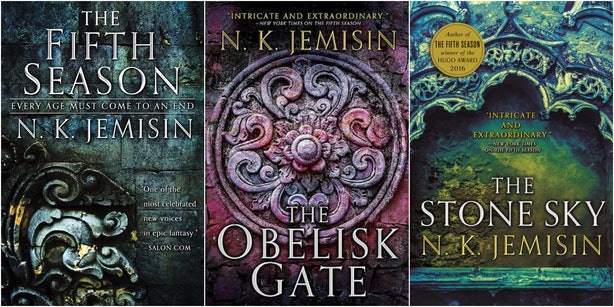
The Broken Earth Trilogy | N.K. Jemisin

The Fifth Season (Broken Earth #1)
by N.K. Jemisin
Published by Orbit (2015)
Rating: ***

The Obelisk Gate (Broken Earth #2)
by N.K. Jemisin
Published by Orbit (2016)
Rating: ****

The Stone Sky (Broken Earth #3)
by N.K. Jemisin
Published by Orbit (2017)
Rating: *****

This year I have several goals I’d like to accomplish with my book-reading. The first, of course, is a target number. What’s more important to me, however, is that I’m able to accomplish reading a diverse set of books over the course of the year. Diverse in terms of genre and in terms of authors I read. And I plan to do this by spending more time searching for books. Additionally, there’s this quest to read authors in full – so I can comment critically on their style of writing. The final desire I have is to be able to critically review books – from a literary perspective, I’d like to understand more about genres and offer more comments on writing.

A small step to that is writing this blog. This context is essential to understand why I read N.K. Jemisin. In 2017 November, I stumbled across Cixin Liu’s Three-Body Problem/Remembrance of Earth’s Past trilogy – which absolutely blew me away. While I was on the Internet, I discovered that Jemisin not only beat Liu’s final installment to a Hugo Award, but bagged herself three consecutive Hugos. That is not an easily accomplishable feat. I have found few Award-winning books to really resonate with me, so I thought I’d give it a shot. This is one of those series’, which for me, built-up over the course of the three books – which is reflected in my ratings of the trilogy.

How do you start to review a series that repeatedly explores the way the world ends?

The premise of the series is intriguing. The Broken Earth trilogy is set on a massive continent called the Stillness, in a far-future Earth wracked with periodic disasters known as Seasons. These Seasons aren’t just bad storms: they’re massive, apocalyptic events that last for generations, reshaping the world and its inhabitants. Those who survive huddle into Comms, protected communities that try to wait out the destruction, then crawl out and rebuild civilization before the next event. There are also remnants of an advanced civilization that persist throughout the destruction: giant, floating crystals called Obelisks.

Among the survivors of humanity are “orogenes,” individuals who can draw incredible magical power from reservoirs of the Earth. But while these orogenes serve a useful purpose for society, their training and treatment is brutal. They’re taken from their homes as children and brought to the Fulcrum, an order that trains and certifies them under the supervision of yet another order, known as the Guardians. When the Seasons come, they’re often singled out for death from Stills, their non-magical counterparts.

Good fantasy is always enjoyable to read because of the origins of thought and premises. In that regard, the series is fantastic. Jemisin is rare in her ability to understand the vastness and scalar nature of time when it comes to geology, but more crucially, is able to apply this understanding to create a sense of linear plot development. Her characters are well-crafted, and the shifting perspectives she provides for the central figures are refreshing and enjoyable, throughout all three books.

My independent assessment of the books, however, largely vary. I believe The Fifth Season was a lot of world-building, which is understandable for a trilogy, but did not create the level of plot engagement that I desired. There’s a lot in terms of plot-line convergence – in that Jemisin tries to reach conclusions to strands of thought that have begun, but in places, the book is agonizingly difficult to read – especially in its description of child abuse. It also made the protagonists difficult to like. If that was a deliberate choice, I think it affected a large part of my reading experience, which reflects in a lower rating.

The Obelisk Gate does a great job of balancing world-building and plot – which reflects in a 4-star rating. I think a large reason why I enjoyed it a little more was also because of the fact that I had context to why the world was so bizarre. If you’re someone who Wikipedia searches for plots and jumps in to the middle of the series, I think it might get slightly difficult to enjoy this one. What I especially enjoyed was the diversity in the cast – something that develops especially here. As a piece of feminist literature, and I use the tag deliberately, the book is able to explain oppression and power-dynamics a lot better than other fictional pieces. It gets you thinking. Being the middle-book, it does a fair enough job of creating longing for the conclusion. I docked points here because the writing and dialogue became boring in parts, dipping in their pace and their efficacy – and I say this as someone who enjoyed Lord of the Rings and other Tolkien works thoroughly.

The Stone Sky is downright incredible. It is the most fitting conclusion to the series, it’s difficult to imagine things ending any other way whatsoever. Jemisin’s writing hits peaks in it’s descriptiveness and it’s sense of apocalyptic society. It mirrors exactly what society is today. If the previous book got me thinking about power dynamics, this book got me thinking about internal prejudices a lot more. The dialogue is extremely powerful – and creates a sense of focus about the human experience and a pleasurable existence, in terms of having a family you love, and a support system that helps you overcome anything in the world. The prose is delightful and enjoyable. The characters make unexpected choices, but reasoned ones – and the reasoning is one that keeps you hooked.

It is, by far the best conclusion to a series I’ve read. I’d recommend the series on the whole – I think it’s worth reading. Fighting breaks in momentum with the first book might take time, but it’s a series that’ll keep you hooked once you start. Every Age must indeed come to an end.

2019: Seventeen

Something I hear very often about myself is that I’m always on the move. People tell me “chill”, “slow down”, “oh no, you’re 5 minutes late”. I’ve never been triggered by it – because it’s a quality very inherent to me. I walk fast, I’ve got a schedule most of the time. It’s just who I am.

But for the first time, hearing it today affected me a lot for some reason. All I could think about the entire time I was off campus – a good one hour today, was whether this is how people saw me. It shook me for a while. Largely because while I do self-identify with being a busy person and keeping myself on my toes, I’m acutely aware of how lazy I am and how much I chill.

I guess my facial expressions and my mannerisms don’t reflect that to people. The only reason it concerned me is because I wondered whether people thought I was less approachable and less likely to converse with them because I’m on the move. The more I thought, the more I analyzed my own behaviour. I remember writing on this blog that I’d like to know everyone on my University campus, by name, if nothing else – and be comfortable sharing a meal with as many people as possible. Reflecting on the exchange today, all I could think about for a few minutes is whether people had thought about initiating conversation with me, but left that pursuit midway because they thought I was busy.

Or whether I’ve just not initiated conversation with people because I’ve had a place to be – whether that’s just a general check on how people are doing, or a “Hey” or a “What’s up?”

That got to me a little. Upon a lot of thinking, I don’t think I have. I do still say Hi to most people I meet on my way to my whereabouts, because I do walk quite fast.

But maybe, just maybe, considering it’s my last 3 semesters in University, I should walk a little slower. And use the pace of my walk only when I need it – like making it to a class just before the bell.

It’s also strange how the brain works. Human psyche is so confusing sometimes – it’s receptive to criticism if it chooses to be in a mood to accept criticism. But sometimes, judgement passed on you can unsettle you.

It’s weird to think that this small piece of judgement unnerved me for an hour. But it did. And I’m a Law student. I guess it’s also time that I accept my limitations a little better.

2019: Sixteen

My laptop crisis has ended with me reverting to my old laptop for now. Which naturally means a lot of memories come flooding back.

I remember picking up this fine piece of technology. Months before I was slated to go into University, I listed out all my specifications – I needed a large screen, a great processor, an amazing keyboard/scrollpad, a DVD drive, a couple of USB slots. And after my dad convinced me out of a lot of inertia, we took a trip to go shopping for the laptop. Comparing 3 stores, we chose which laptop we needed, bought it, and got a lot of free merchandise as well. Heading home was fun. Electing not to use the laptop till University was going to start was a conscious decision – one I broke on my 17th birthday. I thought I deserved that much.

But the memories don’t just lie in the fact that the laptop-shopping was such a wholesome, family event. It also lies in the fact that this laptop has been through such a range of events and emotions, that creating a chronological list would be difficult. It was with my on my first day of college. It saw me cancel flights and book flights – jetting from one University to another. It saw me Skype my parents – and then saw Skype being banned in the UAE.

It saw Trump being elected President.

Wild things, this laptop has seen.

The strange thing though – is because I had done a full clean-up of this machine before I switched over to my new one, the RAM/ROM, permanent storage device doesn’t reflect all the metadata of my activity on this PC. Which means it’s almost like I’m blessed with starting afresh.

And I think strangely, that’s a very poetic way to start the year. A new start to my activity on the interwebs, but also in the manner with which I engage with technology. Changing laptops though is hard work – especially because muscle memory has made me so uber-comfortable with my laptop’s typing layout, that moving across to a new device means I start to type “You” for “YouTube”, but type “UPI” – which basically means the Government thinks I’m a massive supporter of it’s initiatives.

It’s going to be a fun few months of this laptop. I’m eager to see what memories we make this time around.

2019: Fifteen

Ah, we’ve reached my best friend’s birthday already. Which is strange – how quickly one year flies by. 365 days ago I was in the process of recovering from another memorial submission – the last one I would undertake with my moot-mate of three years, and the emotion that came with that definitely overwhelmed me. One year later, that feeling hasn’t changed. I know today, more than ever, that Law school as an experience would be thoroughly different had I not interacted with those seniors in my first year. All I hope for is that some juniors of mine feel that way about my batch when we leave – we’re a nice lot, if I do say so myself.

Not sure why I hope for it – but I think the validation will feel nice, I guess.

In either case, today is my best friend’s birthday. Who is my best friend, you ask? That term for me, is reserved for the friend I have had for the longest amount of time – who has literally seen me through all my phases. My friendship with him is indescribable, more often because as we’ve grown older, it’s become a friendship that’s so self-sustaining that a lot more is said through silence than through words.

We can spend days in each other’s company, and no time with him gets “boring”. We, in fact, just did our first video call today – the first in maybe, 3 years, and I didn’t really find myself wondering why we hadn’t done one before.

He’s one of two reasons I went to Boston. And I’m so happy I did, last April.

I’m glad I managed to surprise him in Bombay as well. The shock on his face was evident, the glee on mine, I’m sure was pretty outwardly too.

A happy 21st to a friend, and a friendship that technology has aided more than ever.

2019: Fourteen

My obsession with food and food shows has made a delightful re-entry into my life.

I think the most delightful part about this obsession is that it hits me when I’m in the hostel. It’s almost impossible to watch a food documentary at home. I can still watch series after series of Masterchef. But documentaries? Those are a no-no.

Speaking of Masterchef, I still remember that we didn’t watch episodes sometimes when my grandparents used to be over (and I was younger, hence, not a rebel), because we weren’t sure whether my grandmother would take me watching about how chicken and beef and pork were cooked very kindly. (Hello Ajji)

That episode still makes me chuckle.

It’s weird. It’s almost like being back at University, and having to eat hostel food means I crave better food automatically. It’s not even like mess food is that bad. It’s average, and is above average on some days. Some days it’s phenomenal. It’s just that it got really repetitive for me last semester.

It’s why I promised my mother I would not go out too much this semester. I can appreciate a good meal when I see one, and my mess does a fine enough job more often than not.

Let’s see how long all this willpower lasts.

Also, my roommate is back! So life should be a lot more entertaining in SF-59 here on out.

2019: Twelve

It’s pretty frustrating to be lied to by someone who has more information than you do. In economics, people talk about information asymmetry affecting the way that markets function. If I was to simplify this, a producer of a good, say, a water bottle, knows how much it actually costs to make the water bottle. You, as a consumer, do not. This allows the producer to charge you more money for the water bottle than it cost for him to make it. He makes a profit. You pay and comply willingly because you’re unaware about the actual cost of the water bottle. This continues at every step of the way, and is how capitalism works.

It’s also how power works. And the service industry works in general.

But why lie? What’s the incentive structure to lying?

I just don’t see it.

All of these broad-based questions arise out of my experience in trying to get my laptop fixed. Remember I spoke about it day before? Well, guess what? It was repaired yesterday. And everything was fine and dandy – I was really glad, and extremely grateful that an inconvenience had been overcome. Until this evening, when the same problem began to act up.

Another trip to the service center was the only solution. I reached there at 5:45, 15 minutes before they shut shop. They told me my warranty didn’t cover the kind of service I was asking for. I fought with them, but they said there’s nothing they can do, and the toll free support was also closed for the day, leaving my hands tied.

A quick search revealed my warranty actually covers me from these repairs.

So why lie?

I think the incentive structure was the opportunity to go home early for a long weekend because of Uttrayan.

Which is quite a good incentive, I’m not going to lie. It sucks that I’m on the receiving end of things though.

Additional thoughts during the day: clipping your nails really finely and then typing is the weirdest sensation you can experience.

That is all.

2019: Eleven

I find several things about winterwear extremely peculiar. It’s always fun to see how quickly wardrobes change when December-January-February rolls around on campus, and how people adapt, improvise, and overcome the terribly chilly winds that swirl around on campus. Everyone switches to pyjamas – and you see some really creative ones, but more crucially, everyone seems to have their own comfortable winter clothing – the kind of clothing they’d lounge in.

Also, oddly enough, winter clothing just looks a lot more comfortable than clothing that you’d typically wear. Hoodies look extremely snug, for example. Especially the ones with kangaroo style pockets. Burying my hands in them always brings a smile to my face.

I think I’m obsessed with winter wear. Which is weird, because my experience of winter as a child was “oh it is a little cooler than normal today”, by which it would be only 30 degrees Celsius instead of 35 or something. And the sweaters would be out.

A part of this obsession lies in that school sweater I used to own. I feel like everyone, at some point in their lives, has had an itchy, woollen, poorly knitted, tight, v-neck, solid colour sweater. Popular colours include navy blue, bottle green, and bright red. It’s a staple of every school uniform, and is the first thing most people turn to for any kind of warmth.

Mine was the bright red variant. And I detested it as a child. As an adolescent, when I moved to India, I began disliking sweaters even more – they were far too itchy for my liking, and removing it always ended up dislodging my glasses or ruining my hair. A simple solution was to be a little careful while removing the sweater, or to take off my glasses prior to starting that process – but that was never my style.

It’s college that has made me fall in love with sweaters once more. Largely because the cold is unbearable without one, but also because my parents have bought me really cute sweaters. I have one they bought from Morocco which looks really Christmassy, and another one we picked up from a school uniform shop – a navy blue, v-necked sweater.

Wearing it reminds me of my 6-year old self, struggling with a tight sweater, and attempting to loosen it by stretching it to maximum capacity. Now I use the tightness of my sweater as motivation to lose the bit of stomach flab that prevents the blue sweater from being incredibly comfortable. I guess the times are a-changing after all.

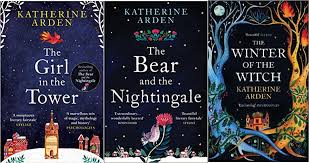
The Winternight Trilogy | Katherine Arden

The Bear and the Nightingale (Winternight #1)
by Katherine Arden
Published by Del Rey Books (2017)
Rating: *****

The Girl in the Tower (Winternight #2)
by Katherine Arden
Published by Del Rey Books (2017)
Rating: *****

The Winter of the Witch (Winternight #3)
by Katherine Arden
Published by Del Rey Books (2019)
Rating: *****

I’ve never posted about this trilogy in the past. Having read it last year, it felt only right that I wait for its conclusion before posting a comprehensive review – because as series’ progress, a lot of thoughts change. The Winter of the Witch, the final part to the trilogy released earlier this week. A few days later, I am pleased to say my thoughts about the series have not shifted since the first book, and my feelings remain unchanged. My personal ranking of the books would be:

  1. The Bear and the Nightingale
  2. The Winter of the Witch
  3. The Girl in the Tower

This fantasy (but-so-much more) series is set in an alternate medieval Russia, where history and myth (from Russian folktales) co-exist. It traces the growth of a young girl, Vasilisa (Vasya), who, having inherited a deep understanding of magic, is thrust with the responsibility of protecting her realm and her family from individuals who seek to destroy it, including from within.

While the first book focuses on her initial years and several tragic happenings (which shape her future decision-making), Vasya grows through the second book. Being ostracized by society, Vasya chooses to immerse herself in defiance of authorities that seek to straddle her powers and limit her choices. She conceals her gender and travels across Russia, befriending and earning the admiration of royalty in Moscow. The final book sees her defending the Russian Empire and owning her gender and the phrase “witch”.

That’s as succinct I can make it, but no amount of plot description is sufficient to detail the narratives that the books create for each character. Arden’s map of character progression is natural and predictable, yet, when events and choices are actually taking place, you find yourself overwhelmed with shock and overcome with emotion. The conclusion of the book is fitting, and perhaps an exemplar of Arden’s planning – it is one that can be foretold, yet alternative endings cannot be imagined.

The books are outwardly feminist, which is also an intriguing, careful choice that Arden makes. Russian folktales are difficult to adapt and retell, but she manages to weave in themes that will resonate with generations, and also sends across several messages relevant to global politics today. The protagonist, Vasya, is very, very badass, and her conduct of herself, especially through the second book, endears her to the reader rather quickly. While trilogies can get drab in the middle book, the pace is racy, and there is a continual sense of something building – keeping you hooked and waiting for the conclusion to the series.

Arden’s style of writing is narrative and vivid. Her attention to detail is exquisite, and it is evident that she has immersed herself in Russian history and culture prior to writing these tales. Her sense of time and setting are fantastic, and the atmospheric nature of her writing make these books an unputdownable read – especially in the winter. Her dialogue is short, but extremely effective, aiding plot progression, and creating meaningful interactions between her characters.

I’m glad also that the series was a trilogy and not more. While there are open-endings that will allow for the fanfiction world to concoct their own tales, Arden does a neat job of helping her protagonist reach a zenith – a fitting manner of conclusion. Anything more might have displaced that, and is a risk I’m grateful she did not take.

I’ve never found myself consumed by folktales as easily as I found myself invested in this series. While that demands me to doff my cap to Arden, I’m eager to see what history she chooses to retell next. The expectations are high.