A Life, Lived | Stoner, by John Williams

Introduction 

My weekend has been filled with reading and books, which is just the weekend I needed to recover for the week that lies ahead. On Friday, I spent a couple of hours on Goodreads, trying to figure out the stuff I wanted to explore and get through by the time Sunday night rolled around. Stoner was a fresh find, an indirect find, so to speak. I saw a book about John Williams’ life – a book that described itself as an essay about why Stoner was the perfect novel, and I was intrigued. I’ve only ever heard of the name John Williams in the context of film scores, so to hear that there was this celebrated novelist I knew nothing about who seemed to have a cult-like following for this “perfect” book, I had to read it. Thus it was that I sat on my desk last evening after a scrumptious meal and I made a new friend: William Stoner.

Also, no, the book is not about weed.

Plot Summary

John Williams navigates you through the life of William Stoner, a lifelong academic and a Professor of English at the University of Missouri. You’re introduced to Stoner posthumously in the first chapter – an introduction that lays down clear benchmarks for the kind of expectations you should have from the book. Williams tells you in no uncertain terms that Stoner was an ordinary man, who had an ordinary career – who did nothing extraordinary. Over the course of subsequent chapters you learn about Stoner’s upbringing on a farm, and you’re transported through the different phases of his life and the different decisions he takes – in finding love, in working on English Literature, in understanding the impact of war. It’s really an unremarkable plot. Quite simply put: it’s one man’s journey through life.

The writing, however, is incredible.

Characters

It’s pretty evident from everything I’ve said above that the character: Stoner, is central to the entire plot. He drives it forward, slows it down, and brings it to a close. Some books which place a singular character at their center, or a singular perspective at the forefront struggle because they don’t establish the character’s voice early on. As a result, expectations are wayward. Williams does this remarkably well.

First, he stays away from writing in the first person at any point. The entire book is told in third person, giving the author more control over the kind of observations he is able to fit in about Stoner’s life – about Stoner’s temperament, for example.

Second, Stoner is set up very, very early on in the book.

You can tell that he’s in for a life of hard work and challenge. This isn’t exclusively because of the description of his farm-upbringing. Williams also achieves this end by labouring through descriptions of Stoner’s entire thought process. When, early on, Stoner is faced with the decision of going to school or continuing to stay on the farm – Williams doesn’t cut to the chase and reach the outcome (Stoner goes to University). Instead, Williams explains everything that terrifies Stoner, what excites him – and why he ends up acceding to his fathers’ pushes. For me, as a reader, it helped me understand Stoner’s motivations, but it also laid out how much thought (sometimes fruitless) the character put into everything he did. Thinking is hard work – and setting up a character who ponders deeply about everything, who doesn’t fully comprehend or rely on intuition early on in the book sets him (and you, the reader) up for everything that you’re going to see.

Third, supporting characters are eased into the story in small batches. Williams makes it clear that the focus is never supposed to be away from Stoner. Even when the scenery changes – like when Stoner moves to University, or the times change – like when World War I breaks out, Williams doesn’t introduce more than 2 characters into Stoner’s life arc. This clarity of writing allows each individual’s character arc to develop fully (only one character is written out early – killed in action), but more crucially, it allows Williams to lay out, slowly, Stoner’s dynamic and interaction with each person. That enables them to be more organically involved in Stoner’s life. This is best illustrated not through Edith, but through Gordon Finch. Finch is introduced as a friend. Stoner and Finch get on really well – exchanging observations about University life that you’d only ever exchange with your closest peers. Finch disappears, enlisting for the war, and returns in an administrative capacity more senior to Stoner. However, their rapport doesn’t change – and lasts right through to the end. Now, Finch was introduced with another character, Masters (the character who dies young). In my view, settling on a small group reflects the reality of the life of an academic. More central to the argument I was making though, is the fact that it allows for the development of more meaningful interactions with these characters – which keeps the spotlight on Stoner. As the reader, you’re rarely caught onto picking a favourite character: you’re firmly on Stoner’s side, interested solely in the kind of relationship and impact each character will have on his life.

Conflict

After I read the book, I went on to read a few essays I mentioned earlier – about why Stoner was the perfect novel, and they all point to the way conflict is explored. Each one of them highlighted how conflict was introduced at exactly when it needed to be in Stoner’s arc.

While I agree with that, I think some nuance exists in the kind of conflicts introduced. There are the big conflicts: the one with Lomax, the affair Stoner has and the conflict with Edith, the conflict when he tells his parents about continuing on with his studies in English Literature. However, conflict remains a central theme throughout the book – one that shouldn’t be ignored. Williams’ success doesn’t lie exclusively in the fact that he is able to introduce these big conflicts at the right time.

To me, a large portion of that success is owed to the lucidity of his writing of an internal monologue and the internal conflict that Stoner faces almost on a daily basis. We’ve explored this in the above section – on how this helps set up Stoner’s character. Here, what I’d like to concentrate on is the role of this internal monologue in those bigger conflict arcs.

I shall illustrate this through the conflict with Lomax (the conflict with Edith has too many layers and will give away too much of the book). Professor Lomax is another faculty in the English department who Stoner has several scuffles with, climaxing in the big scuffle regarding whether a particular graduate/doctoral student should receive passing marks in his oral examination. Now, while this entire scuffle could have been projected through the single dimension of being an indirect power struggle in the department between Lomax and Stoner, a large amount of the conflict’s introduction takes place through the internal monologue.

Stoner first notices this student when he sits for a graduate seminar Stoner teaches – and Williams elaborates Stoner’s thoughts at the start. In fact, Williams creates a narrative of doubt through every interaction that Stoner has with the graduate student – which culminates the introduction of the conflict with Lomax. Without these deliberate portions of the narrative devoted to exploring Stoner’s internal dilemma about how the student in question has been admitted, the larger conflict loses value. More importantly, what Williams is able to achieve is the opportunity to introduce a counter-narrative and a counter-characterization that is equally powerful by allowing Lomax to replay the entire monologue from a different perspective.

It is a phenomenal lesson in storytelling.

Concluding Remarks

I recognize that a large part of my analysis may not make sense without a reading of the book. Hence, please read the book. It is short and well worth any time you may have. The Guardian wrote about how the book had a ‘sad tone’, and how Williams himself was confused at why people thought Stoner led a sad life. I have to agree. There is a sadness to Stoner, but there is also joy – in equal part. Remember, Stoner’s life is ordinary. It is relatable. Therein lies it’s power.

I loved the book. As someone contemplating a career in the academy, this was just a beautifully told tale of someone determined to teach, and to love, to the best of his capabilities – while making mistakes along the way. A life truly lived. Another great book I’ve read in 2020, earning ***** (5 stars).

Old Dog, New Tricks | Play It Again, by Alan Rusbridger

Introduction

First off, I must apologize for the title. I tried long and hard to find something more suitable, but nothing felt quite as right as this did. Apologies, Mr. Rusbridger, if you do read this.

Secondly, some context. This marvelous book was recommended to me by the genie that is Goodreads, thanks not in small part to my recent completion of another book on classical music (which I should hopefully review shortly), and the fact that Year of Wonder is now a book I am currently reading. My own history with classical music is long and storied. It forms a part of a poem, and a blogpost from early 2016. At present, I am falling in love with it all over again. I’ve begun piano classes, I listen to more classical pieces, I’m engaging with my own study of music theory – and I’m enjoying every bit of it. However, it has been 6 years since I properly attended lessons and focused on technique instead of playing things by the ear. As a consequence, my dexterity is something I am relearning. In that sense, finding this book felt like more than a coincidence. My review might therefore be coloured by this experience.

Plot Summary 

Pretty straightforward really. Rusbridger explains it in a video he recorded, which you can see here. In a series of diary-style entries, Rusbridger recounts taking up the challenge to learn and play Chopin’s Ballade No.1 in G minor Op. 23, which is one of the most daunting pieces of music ever written. There are added layers to the challenge, though. First, he gave up the piano when he was 16, and took it up as a serious hobby only past the age of 40. Second, he’s got a day-job (and not any day-job. At the time, he was Editor-in-Chief of The Guardian). Third, he wants to learn it in a year – committing to do so by giving himself 20 minutes a day of dedicated practice. To anybody, developing a habit over the course of a year by attempting it for just 20 minutes of a day sounds ludicrous enough. To commit to learning a fresh piece of music – and something that lasts 10 whole minutes isn’t just committing to a habit – it’s committing to teaching yourself something new that develops on past knowledge, which is incredible.

To give you a spoiler alert: yes, he manages to play it, and rather successfully, I might add. There are snippets of his playing in the video I’ve linked above.

The Writing 

I’ve often found that diary-style entries face the arduous challenge of establishing context in as few words as possible before developing plot, or rather, furthering plot in a manner that is engaging, yet succinct. Some preliminary comments on length and style before analyzing the writing itself.

Some books written as journal or diary entries end up writing these extracts at length. They feel well-edited, meticulously-crafted – that the thoughts come in a structured manner, or a structured flow at all points of time. While it is arguable that journal/diary writers do spend time thinking about what they wish to write about, I often feel that there is an erosion of the unfiltered thought that takes place when they are crafted to be literary. There’s a beauty to the natural flow of thought when somebody sits down with a pen and paper to write – the brain hops, skips, and jumps, and you can see that with the writing. It feels organic, and natural, with stops that are as abrupt as these thoughts themselves. There is no doubt to Rusbridger’s talent in the English language (he studied at Cambridge and was a journalist, for goodness sakes’), but what I loved here is that the diary entries never felt too long. While we do not know whether these were extracts culled out of longer pieces of writing from each day, there’s a flow to the book that feels like I could’ve sat and written it at home.

This does two things for me: one, it makes it incredibly easy to read, even when it’s discussing something like the art of choosing which piano to buy – something that is incredibly boring if you cannot hear the tone of the pianos being compared and the subtle differences in tone. Two, it makes the amateur portion of his piano playing feel more genuine. You can see that this is something he is incredibly passionate about – (at least this one project), but having the writing laid out in a very amateur-like way makes it feel more relatable.

Interweaving Subplots and Interviews 

The book would have been incredibly boring to the general public if it was exclusively about him learning new sections of the piece each day, with stylistic changes being described as if you understand everything about how the piano is to be played. It would make for excellent technical reading, and I wouldn’t mind reading that too, but that’s for another day. There’s a lot going on in Rusbridger’s life, as I pointed out. There is success not only in the fact that he does play the piece at the end of the book, but that he doggedly and determinedly ensures he gets in as much practice as possible whenever he finds the time.

It’s evident that he needs to make the time for this hobby. He explains, at different junctures, the WikiLeaks stories, the phone hacking scandals, and other stories – including the rescue of a Guardian reporter from Libya (where he conceives the title of the book). All of this means that pages turn not exclusively because you’re interested in finding out more about his journey with the piece, but also because you’re trying to figure out whether or not he’s succeeding in the other things that are the top of the priority list for the paper and for him.

While that is admirable, what I enjoyed even more was the fact that he presented the art of learning this piece in a very holistic manner. It isn’t him self-learning, or self-teaching the piece. In technicality, once you learn how to read music, you can pretty much learn how to play anything – for playing sakes’. It’s clear that he doesn’t want this. He enrols in regular lessons, which you can see changes his perspective on the piece by giving him an observer to play to every time he visits. There are nuggets of information from professional pianists whom he has the opportunity to spend time with (as a result of his day-job), and all their interpretations offers him with the chance to look at the music through his own eyes – and reflect in the music a story that he connects with, which I think is beautiful. He also speaks to neuroscientists to understand the art of memory and learning an instrument better in an attempt to figure out what the easiest way to commit the piece to his brain would be.

All of this portrays Western classical music and its performance as being so much more than the random notes and squiggles on a staff. Indeed, in various moments, Rusbridger taps into his historical knowledge to offer different views on the context and meaning of Chopin, which I absolutely adored.

The Personality 

This would’ve also been a little less interesting if the writing didn’t allow the personal side of the story to shine through. I’ve stated above how personal the challenge itself becomes, but Rusbridger takes that one step forward, involving the reader in several aspects and decisions he’s taking on the fly. This includes the fact that he ends up building a music room in his house, he buys a piano, and he attends a couple of amateur piano conferences. There is humour interspersed in his own reflections of the kind of mountain he’s trying to climb – all of which really allows you to see who Rusbridge is beyond this singular focus he has for a year.

Conclusion

Listen to a performance of Chopin’s Ballade. Then read the book. It’s a wonderful exposition of how immersive classical music, or any hobby can be really. For me, it’s deepened my own resolve to learn the piano to enjoy it as much as I possibly can, given the history I’ve got with the instrument. It’s also convinced me that I can learn new things at any age, and I’m never going to be dissuaded by my age as an excuse to learn a skill I’m interested in. Without much doubt, this book earns ***** (5 stars).

Mother, Memory & Mumbai | Em and the Big Hoom, by Jerry Pinto

Introduction

I’ve been searching for this book for two years, trying to get my hands on a copy without much success. Till I found the digitized version of the book on the Internet Archive this afternoon, and thus successfully immersed myself in the storytelling of Jerry Pinto for the rest of my Sunday.

It becomes clear almost instantly that this is a tale that is extremely personal. This isn’t some specific trait in the book itself, but an amalgam of several features: the first-person narrator, the creative use of dialogue, the emotional responses, and the anecdotal knowledge attached to every interaction. Pinto makes you very aware, right from when he first mentions Sir JJ Hospital, that what you’re reading is a part of him. A little bit of research after reading the book confirmed this for me: while this is a piece of fiction, there are blurred lines between the source of his inspiration and the words that find themselves on paper. Pinto’s own mother suffered from bipolar disorder, and the original version of this story was accurate to a fault, leading to its abandonment. A rigorous editing process (clearly) led to a draft that was originally 750,000 words being cut down to its final form (definitely way lesser than that number). Everyone knows these nuggets about Pinto and his writing, and there are enough interviews available on the internet to indulge you more.

I’d like to focus on what made the book special to read for me. There are a few spoilers ahead, and I do hope you won’t mind them. If you’re going to stop reading this piece here because of those spoilers, here is a short summary of my “review”: please read the book, for it is a fine piece of literary fiction that will warm the cockles of your heart and take you on a journey where you know about the horrors that lie ahead, but you wish to go on nonetheless.

Moving ahead.

Plot Summary

The story centers around the narrator, his sister Susan, his mother: Em, his father: the big Hoom, and his Grandmother. Em has suicidal tendencies and suffers with issues with mental health. The book is told through a series of interviews, conversations, and anecdotes from the narrator’s interactions with Em and the big Hoom. Em’s health forms a large part of the narrative structure and arc, forming the focal point of a story about a family that is collectively navigating the human condition.

I found three things particularly poignant about the way this story was told

Conversations

Writing in past tense, the narrator never puts himself at the center of any part of the story, except where he experiences grief. Most of the story is told through conversation, which accomplishes a few things. First, it moves the plot forward naturally, without much effort. The narrator at no point defines a moment of time when these conversations are taking place, and the progression of the conversation serves a useful tool to examine Em’s condition in all of its phases. Mental health isn’t a linear, tangible concept, the way physical health is, and Pinto uses conversation to showcase the highs and the lows of her condition. Second, it allows for the narrator to insert reflections on what he’s just heard at any point of time – enabling for engagement with the narrator’s character. I appreciated the use of conversation as a tool because it allowed for us to get a better glimpse of the narrator’s thoughts without being stuck through pages and pages of reflective material. Finally, it allowed for the creation of character voices in a manner that’s unique to conversational tales. In introducing characters: Susan, the Big Hoom, and even Granny, Pinto is able to give them a unique inflection – in their tone, in the manner they speak, and the value they add to the discussion taking place. Em’s personality contrasts the Big Hoom’s in subtle ways, and Susan’s relationship with the narrator develops through things said but left unsaid – especially toward the latter half of the book, when there are multiple episodes of grief. It also allows for a more clear picture of character consistency: Granny’s inability to string together sentences in English throughout the book speaks to her own history and the various languages she thinks in and hears.

Love and Helplessness 

A universally accepted fact is that it is difficult to see the ones you love suffering. A mature understanding of this helplessness one faces at times is the realization that there is only so much one can do; and with mental health, it is often understood that some battles are personal – and are confronted personally. The narrator gets exposure to this in his youth, which naturally leaves an impression on him for the rest of his life – and you get a sense for the depth of that pain of helplessness where Pinto describes an interaction with Em on one of his hospital visits after she suffers through an evening. He sits by her and holds her hand, in an attempt to provide her with some comfort. Em acknowledges this act, but in acknowledging it so, pushes the narrator forward to doing his own work – rather than sitting by her and watching her. That scene was particularly numbing, and Pinto’s description of seeing his mother suffer shines through here, along with the recognition that the narrator is caught in two minds about moving forward and staying back.

This helplessness also shines through in an attempt to reconstruct Em’s life through the novel as best as possible to try to find a trigger for her suffering. At various junctures, and in different circumstances, the narrator comments: perhaps this is when things go awry – to figure out a tangible externality that impacted Em so. We leave the book without full knowledge of Em’s condition, of what her trigger was, and whether she’s always felt this way. His understanding of nuance in mental health, of how sometimes there is no definite moment, or definite circumstance you can point to for how you are feeling, and the complexity of brain science shone through. This investigation into Em’s condition is left incomplete, and it feels like that was deliberate – a decision I fully endorse.

Loss

Loss is a part of the book. It is ingrained in every chapter, every story that the narrator and Em recount. The loss of memory, Em’s slow deterioration, and eventual death. Loss is first presented to us as a metaphor: pianos that were thrown from boats when Catholics migrated to India. That pain, that loss of music, it pokes at you in subtle ways throughout the book before culminating in the final few pages. Nobody knows how to respond to this loss, and there is no appropriate response – and you can see the confusion that spreads through Susan, the big Hoom, and the narrator (presumably Jerry) – in their decision to consume alcohol instead of tea, before realizing tea suits them better, in the copious amounts of food they’ve ordered. Pinto completes this story the only way it should have ended – with Em’s life being told to an extent, with mystery over parts of her that nobody understood, and parts nobody will understand. Humans are complicated beings, and Pinto is not worried about hiding from that truth.

Additional Remarks

It is pretty evident that there is a lot of love in the book itself. The authenticity of the story shines through at all points – there is no question about that. Pinto reflects on Bombay in a manner that unique to Bombay authors, something I found when I read Suketu Mehta’s Maximum City as well. Bombay is a city with a confluence of souls – an understated part of that city that reveals itself only when you stay there for sometime and revel in its personality. In several ways: in interactions with minor characters who make recurring appearances, in the description of Em’s household and her childhood upbringing – that is brought out. And it’s beautifully done.

Pinto also tackles taboo subjects – like sex, with an aloofness that allows for it to seep into regular conversation in the narrator’s household. Em’s personality is a large part of this, but you can see the distinction in which a mother brings it up with her son, viz a viz a father – who gives him an encyclopedia and explains things to him. There is humour, but you need to search for it, and this contributes to some of that.

Conclusion

A wholly befitting ***** (5 stars). Phenomenally written, with a journey that comes from the heart. I choked up repeatedly, which is not what I had in mind for this evening, but I would gladly do this all over again.

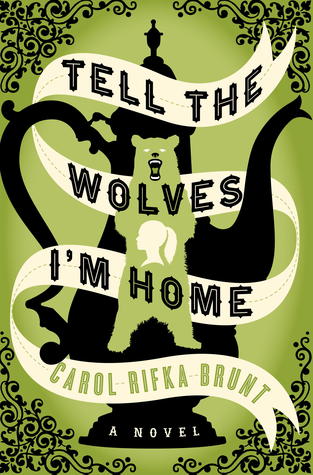
Tell the Wolves I’m Home | Carol Rifka Brunt

Tell the Wolves I’m Home
by Carol Rifka Brunt,
Published by Random House (2012)
Rating: **** 

This is a very touching tale. It was a good pick after Black Leopard, Red Wolf – especially because of the kind of emotions I was left it at the end of that book, the eerie, not so optimistic kind.

The book itself is very layered, but centers itself around a singular premise: grief. June is forced to cope with the death of her beloved uncle Finn, a gay man in the 80’s who passes away as a result of AIDS. She has grown up resenting her uncle’s boyfriend, Toby: a man blamed by her parents for her uncle’s death. June and Toby were also often competing for her uncle’s affection, attention, and time, leading to a complex relationship. His passing forges an unexpected friendship between these two individuals. June’s uncle was an artist, and through discovery of his art, we learn how grief impacts two people close to the departed and the way they share in their sorrows and their joyful memories.

There’s an emotional weight to the writing. Their friendship begins with a posthumous gift that Finn gifts to June through Toby. June slowly discovers Finn’s spirit living on in Toby – who replaces Finn as an uncle-figure in her life.

Rifka Brunt’s writing is enjoyable. The book itself, is wholesome. I’m not left with unanswered questions or unresolved emotions – but moral conflicts that are easily resolved, and a story that feels complete. I docked a star for its simplicity. Things seemed too convenient, for me – and I would have appreciated if June’s voice was a little more suited to her age throughout the book. Often it felt that Brunt purposefully chose a voice younger that June’s actual age, which takes away from the kind of relatability the book enjoys.

For the imagery and the symbolism, and the description of grief and friendship, this is worth reading.

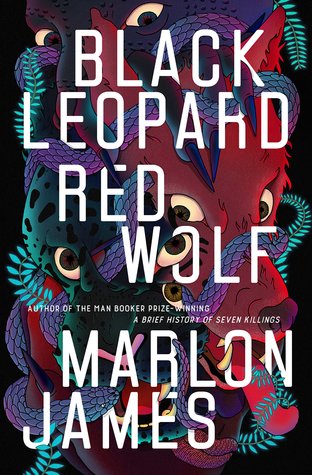
Black Leopard, Red Wolf | Marlon James (The Dark Star Trilogy, #1)

Black Leopard, Red Wolf (The Dark Star Trilogy, #1)
by Marlon James,
Published by Riverhead Books (2019)
Rating: ****

This is a book that proclaimed to be an African Game of Thrones. Its publication was pretty timely, given that Game of Thrones (the TV series) was due to end in May, 2019. That comparison, however, would carry the weight of what George R.R. Martin had written through his novels so far, with the conclusion of that series presently awaited. Irrespective of the comparison, which I will address later, I think this is an African fantasy series which I will follow, and I am looking forward to reading the next installment soon. The strength of the writing derives in its ability to blend, uniquely, African mythology and narrative – while staying true to the voice James tries to give his characters.

First, we must address the structure of the tale. We’re introduced to a narrator, and the novel itself begins with one of the eeriest opening lines that come to memory,

“The child is dead. There is nothing left to know.” 

Who is the child? How did they die? Who knew the child would die? Did anyone? Could someone have prevented it? Who says these lines?

We are, almost instantly, introduced to Tracker. We learn he is a hunted, renowned for his skill. We learn, that as with others who are at the top of their craft, he has principles he follows while working. We learn one of these was that he worked alone. We also learnt he broke that principle – learning to work in a group, and searching for a boy. (At which point you wonder whether this boy is the same child referred to above). James structures the novel as a series of chapters where Tracker takes you through a part of the plot, containing an event, or events, or introducing characters and stories which form part of a larger narration. Each of these ends “But that is not the story.”

That structure is pulled off marvelously. Its the first time I’ve noticed such explicit messaging by authors pushing individuals to read the next chapter. But that’s not the only purpose it serves. It heightens a lot of the intrigue, and the mystery, and foreshadows the ending beautifully – for you’re always left in wonder about what James’, (and Tracker’s) endgoals are. The unpredictability served me well.

This is very dark writing. There’s a lot of violence, some gory imagery, and a lot of opiod description. There’s a malevolence that hangs in the air throughout the novel, which I think is something that’s reminiscent of Game of Thrones. And contrary to what other leading reviews say, I don’t believe that this story lacks subtlety. The reason I say this is because we don’t know what the forthcoming installments in the series will bring – and there could be several plot points, or introduced elements that James chooses to use.

I docked a star because for the promise of description, there’s little to excite the imagination about the forests Tracker lurks. There is description of several things, but not much about the setting – in places where there could be. The other element that made me uncomfortable was the uncertainty with which some decisions in writing were made. There appears to be a lot of confusion, for example, about Trackers’ own identity (his sexuality, for example). If that was a deliberate decision, and I can understand why authors might choose to do that (for it mirrors the confusing nature of the spectrum in reality; and the conflict one often fees), it was written without care.

I hope James fixes that. The latter more than the former.

For everyone else looking to dive into African fantasy or African mythology, and to have your mind absolutely blown by a swarm of plot – this is a book you need to pick up. It will leave you baffled and craving more, and if you’re me – you will spend a night collecting material on African origin stories and mythology.  And then you’ll watch Black Panther.

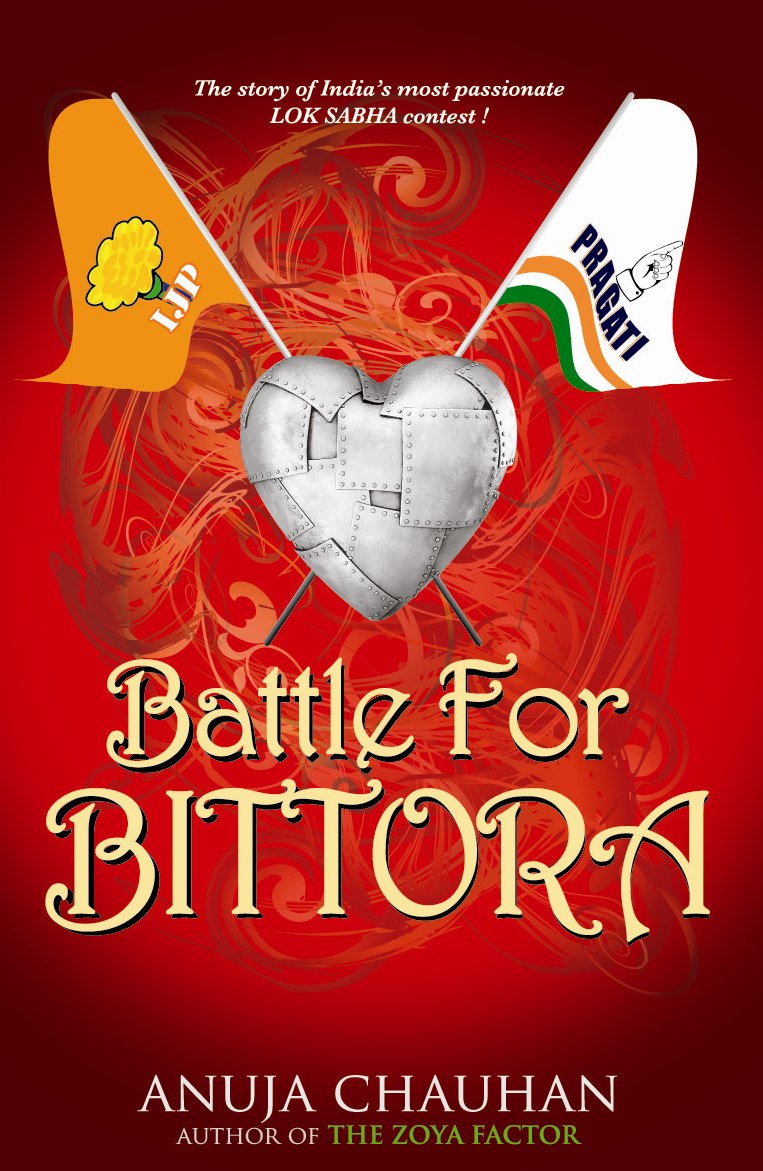
Battle for Bittora | Anuja Chauhan

Battle for Bittora,
by Anuja Chauhan,
Rating: **** 

This year, I’ve sought to read books I would not ordinarily have read. Largely, this is an attempt to broaden my horizons in terms of the material that I give time to. The Indian authors I read during my teenage years always felt Chetan Bhagat inspired. After I read my first Chetan Bhagat novel, I was certain that his books were written for the big screen. This was a notion that was confirmed really quickly – with movies inspired by his novels becoming box-office blockbusters.

Reading Anuja Chauhan made me feel the same thing. That her book is destined for the big screen. To categorize her with Chetan Bhagat, however, would be misleading. Her brand of humour is unique and far more witty than Bhagat’s, and her characters do not have a comparable level of pretense.

At the book’s center is 25 year old Jinni (Sarojini) who lives and works in Mumbai is perfectly happy with her carefree and happy existence. This is till her grandmother, a veteran politician herself, informs Jinni to drop everything and contest from their hometown Bittora. As a result of this bullying, Jinni’s life turns upside down, moving from Mumbai to campaigning as the Pragati party MP Candidate in Bittora. The book takes us through her campaign trail, as she slowly understands the nuances of politics – right from how her friends become her enemies, to how her campaign is actually funded.

The book gets more fun when her main rival is introduced: a childhood friend Zain Altaf Khan. An ex-Royal of Bittora, Zain is a candidate of IJP, a largely pro-Hindu, extreme party, which by fielding a Muslim candidate is trying to signal a change of its party ideologies. As is predictable, the love story which develops between these two protagonists is what drives the book, around the political drama which transpires as well.

As a light-hearted read, the book is phenomenal. There’s a tinge of political commentary, but that’s not the main feature here. Chauhan is liberal with her use of Hinglish, making the book extremely relatable. The slang is hilarious, with words like “Saakshaat fart” to describe people, and “kitaanu animator” to describe Jinni’s job profile. The jokes are terrible and will inspire a laugh riot, with characters like “our Pappu” being developed purely through jokes. And of course, as with every Indian family, there’s an aunty who tries to get in the way of things – which just adds to the masala.

I’d recommend this book to everybody. I gave it 4-stars because I thought it got a little dry in parts, in terms of the writing. But it’s worth the read, especially if you need some laughter therapy.

The Red-Haired Woman | Orhan Pamuk

The Red-Haired Woman,
by Orhan Pamuk,
Published by Knopf (2017)
Rating: ****

I had a hard time getting into this book. But when I did, I found that I enjoyed it more than I’ve enjoyed reading other novels Pamuk has written. The book’s appeal probably also lies in the fact that it is one of his shorter works.

The story falls into three parts, each of which is quite distinct.

The first part is both the simplest and the easiest to like. The narrator Cem tells of a job he took after his father, who was involved in a left wing group, had disappeared and before his university entrance exams. This involved working as an apprentice to a traditional well-digger. The story describes the process of well-digging and Cem’s relationship with his master, a father figure who tells him stories. Cem becomes obsessed with the red-haired woman of the title, and eventually discovers that she works in a travelling theatre with her husband. This part comes to a dramatic conclusion.

In the second part ,the older narrator continues the story and describes his progression, first in marrying, then by running a company that invests in developing new suburbs of Istanbul, one of which is the town in which the first part is set. The company becomes very successful, Cem discovers that his master survived and succeeded in finding water and completing the well, and that the red-haired woman was a former lover of his father, and the son of the red-haired woman claims that Cem is his father. This story also builds to a dramatic confrontation in which Cem is led by a man claiming to be his son’s friend to see the well, eventually revealing himself as the son, leading to a fight in which Cem’s gun is fired. So if the first part paralleled Oedipus, this is closer to Rostam and Sohrab.

The third part is related by the red-haired woman, which made for an interesting change of perspective. The son is in prison accused of Cem’s murder, and she visits him and tells him her story and Cem’s. She encourages him to write his father’s story, which explains how the first two parts came to be written.

This is a book meant for an introduction into the world of Orhan Pamuk. It is reflective of everything associated with his writing: a depth of plot, complex characters, intriguing perspectives, and so much more. It’s also reflective of my biggest criticism of Pamuk – that he tries to do too much. There are parts here which feel forced, and unnecessary, as with several other works of his. As a result, it’s a perfect introduction, and good material to assess whether or not you’ll enjoy reading Orhan Pamuk.

Silent House | Orhan Pamuk

Silent House,
by Orhan Pamuk, translated by Robert Finn
Published by Knopf (2012)
Rating: ****

Perhaps one of Pamuk’s most politically-charged works, Silent House is a really, really good read. The novel takes place against the backdrop of the military coup of 1980, and provides an opportunity to understand the relationship between Turkey’s political and military establishment through the experience of the common-man.

The plot is this. The Darvinoglu family gathers for its annual reunion at the crumbling ancestral mansion in the resort town of Cennethisar, near Istanbul. Into the mix of clashing personalities, gossip, plans and barely buried grudges that are usually part of such reunions, this book adds debates over religion, Turkey’s divided feelings about belonging to Europe or the Middle East, and hints of the looming coup. The national schism is dramatically personified in Hasan, the illegitimate teenage grandson of the family patriarch, Selahattin. Frustrated by his poverty and flunking out of school, Hasan tries to curry favour with an ultra-nationalist vigilante group, while at the same time stalking Nilgün, the beautiful, cheerful, communist-leaning granddaughter.

The book explores Turkey like none of Pamuk’s other works do – by providing insight into how families operate in such a confusing atmosphere. It provides explanations to thought patterns of the right-wing and the extremists, as well as to the understanding of Turkish culture that the centrists and the left-wing holds.

What is particularly enjoyable is the writing style, with each of the characters in the Darvinoglu family getting their own first-person perspective, which allows you to shift between the experiences of each of them individually, and the family as a collective.

This is a good book. There’s no more commentary I would like to offer. It is insightful, engaging, and fast – and worth reading.

My Name Is Red | Orhan Pamuk

My Name is Red,
by Orhan Pamuk, translated by Erdağ M. Göknar
Published by Vintage (2002)
Rating: ***** 

I’m not sure I will be able to do justice to the plot of My Name Is Red. It’s difficult to put into words. In essence, it is a murder mystery. An individual, Elegant has been murdered, and his corpse lies undiscovered at the bottom of a well. Speaking from the afterlife, he hopes that his body is found soon and that the murderer is captured.

However, Elegant is not the sole narrator through the book. Each fresh chapter introduces a new character to the story, and ends up explaining their backstory, alongwith how much they know about the murder of Elegant. As we learn more about the motives for murder, so we learn about the motives behind art, and the possibilities of its interpretation.

Pamuk’s consistency with exploring the blurring of lines in the confluence between the East and the West continues here as well. Each narrator, though modernist, has an intriguing take on the value and role of art in a person’s life. So too, does each narrator have a perspective on whom the likely murderer is. Pamuk unravels the plot slowly, allowing for these philosophical discussions and beliefs to be exposed in as nuanced a manner as possible. Pamuk manages to portray the 16th century world, full of its own contradictions, and capture it in a manner that is wholesome and enjoyable.

However, if you are reading Pamuk purely for the murder mystery – this might not live up to your expectations. There’s barely any distinction drawn in the likelihood that one of the narrators may have murdered elegant, which leaves room for a lot of doubt, and a lot of tension, one that Pamuk diffuses in a manner that isn’t all that appreciable. The narratives is skewed and feels heavily-strung together.

As a result, Pamuk’s novel gets 5-stars on its value as a text and its contribution to my understanding of ideas that it presents – lucid, simplistic, and detailed. However, as a pure literary text, my jury will have to wait for a re-read. Or multiple re-reads.

Snow | Orhan Pamuk

Snow,
by Orhan Pamuk, translated by Maureen Freely
Published by Vintage International (2005)
Rating: **** 

Snow is essential reading.

In two distinct parts, the book follows the story of Ka (the shortened form of Kar, which is “Snow” in Turkish).

The first part follows Ka’s discovery of Islam. It begins as Ka reunites with Ipek (a woman he once loved), who has recently divorced Muhtar, owing to his interest in political Islam. Ka meets Muhtar, and is introduced to Muhtar’s experience with Islam. During that meeting, he is accused, alongwith Muhtar, for a recent public shooting for which an Islamic extremist group claimed responsibility.

Ka begins to write, composing a poem, “Snow”, and several other poems. Ipek urges Ka to visit a Sheikh, and they have an astounding conversation on the value of organized religion in an individual’s life. Ka, although hesitant to accept religion – claiming it to be “backward”, chooses to accept instead, that his poetry is a gift from God – an unnamed entity. Following this interaction, Ka continues to meet people with different experiences of Islam. He meets a self-identifying Muslim radical as well as Islamic feminists.

Reflective of a newly independent Turkey, there are growing tensions between secularists and Islamists, which ends up blowing out of proportion at a televised event. The police and military impose martial law, and Ka is taking in for questioning once more. Upon his release, he meets an actor who identifies as a Turkist Republican, who ends up orchestrating – in a spectacular sequence, both a coup d’état and a coup de théâtre.

The second part deals with a denouncing of the coup. True to Pamuk, there is a post-modernism in his introduction as the narrator of the book. We fast-forward four years, and explore Turkey post-Ka’s life, and reconstruct events leading to his demise.

You’ll notice that my plot summary elaborates one part of the book far more than it does the second. This is intentional. If you’re intrigued by what the first part holds, the second part is a deeper dive into all things so related, and I would recommend reading the book to find out more.

The characters are phenomenally crafted. My usual criticism of Pamuk involves a comment on how characters are just one-dimensional individuals. But here, every single character is developed well, with backstories that keep you hooked, and motives that you find yourself questioning at every turn. There is no black-and-white, only grey, and it’s very easy to fall in love with, and hate Ka and his crew.

A truth that has been fundamental to Turkey has been its struggle with who it wishes to be, who its leaders wish to represent, and how to unite a population that has such fundamentally different beliefs. Pamuk’s reflections on this struggle is a driving force behind Snow’s plot, and is an exposition both in Turkish society, and a commentary on the ability of speech – to propagate messages of peace and unity, as well as violence.

One star is docked again for Pamuk’s staunch refusal to allow us to fully immerse ourselves in the world of his characters. Similar to the New Life, he reveals nothing of Ka’s poems – making it difficult to fully relate to Ka’s perception of the world, and more crucially, fully appreciate certain scenes that Orhan the narrator weaves for us.

However, an understanding of Western Asia would mandate a reading of Snow. And I would force it upon people as well.

The New Life | Orhan Pamuk

The New Life,
by Orhan Pamuk, translated by Guneli Gun
Published by Faber and Faber (1997)
Rating: ***

Reading Orhan Pamuk is an exercise in learning and unlearning. This book was the third in my journey of understanding the author.

The New Life follows the journey of individuals who, captivated by a book they read, seek to implement its principles, and achieve its conclusion – the prospect of a new life. The protagonist, Osman, notices the book as his friend, Janan sets it down – buying his own copy shortly thereafter. Subsequently, Janan introduces Osman to her boyfriend, Mehmet – who is shortly gunned down at a bus stop. As Mehmet is untraceable, Janan and Osman end up taking bus journeys – which are violent, and surreal, in an attempt to find Mehmet. Ultimately, they find Mehmet’s father, Dr. Fine, who – as the antagonist in the story, has attempted to curb the readership of the book, by murdering individuals who follow its teachings using a network of spies. The book concludes with a revelation of the book’s actual author – who is related to Osman.

This is a summary of the plot. The nuance involved, along with Pamuk’s writing style, makes this an extremely heavy, complex read. As a result, unlike his other works, I don’t think this is his most accessible novel. It left me feeling several mixed feelings. Before we get to criticisms however, Pamuk deserves appreciation.

As always, his storytelling will leave you with a sense of wonder and bewilderment. There’s a lot of depth, and while sometimes difficult to follow, Pamuk’s imagination is a credit to mankind’s thinking. Technically, Pamuk achieves Inception-level writing in the 90’s – something that only took to the screens much later.  Again, quintessentially true to style, there are scathing observations on Turkey’s complex, confused character, and remarks on the West. Further, the existentialism Osman faces – which leaves him in quest for a New Life, and his eventual succumbing to that quest, is something that is relatable across generations.

While the ideas and layering is grand, the writing here lacks a lot of precision. The prose here is heavy. Descriptions, for example, are over-done. Sentences are lengthy, and complicated. As a result, Osman’s introspection is overly complicated, rather than simplistically presented. Additionally, Pamuk appears to have a thing for disappearing acts. Reading this after The Black Book made them seem far too similar, and expectations were heightened.

Further, Pamuk doesn’t develop his characters as much as he usually does. There’s too much similarity between Osman and Janan. Their chemistry is far too quickly created, and progresses only as a result of their commonalities. Their friendship, and unrequited romance, is not organic, insofar as their personalities do not show any progression – aside from their sole focus being to find Mehmet.

Finally, I think what the book could have done with, is some exposition of the book that Osman, Janan and Mehmet all read. I understand that the crowd is split on this, but Pamuk tries to leave it to the reader to figure out what the book was about, and what the “new life” the book propagated actually is. In a sense, this is fantastic – it’s so subjective, and open to interpretation, that it allows the reader to soak in all this information and formulate an opinion. On the other hand, the motivation of these characters is so grey, and difficult to  pinpoint. Some excerpts – perhaps two lines, even, at the start of chapters, would have been fantastic.

In short, this is a more of a case of “what could have been” rather than “what is”. If you’re intrigued by Pamuk, it’s worth the shot, but shouldn’t be your first pick.

The Black Book | Orhan Pamuk

The Black Book
by Orhan Pamuk, translated by Maureen Freely
Published by Vintage (2006)
Rating: ****

As an exposition of Turkish culture, only the Turkish or individuals with intricate knowledge of the Mediterranean nation’s history can comment on the accuracy of The Black Book. I do not claim to be an expert in this field. As a result, my comments on Turkishness are restricted to plot points which stood out to me. Nonetheless, it is impossible to read Pamuk, even the translated version, and miss his identity and the influence of his surroundings on the book.

The Black Book opens with rhe protagonist, Galip, finding that his wife/first cousin Rüya has left him. Over the course of the novel, he attempts to hunt her down in Istanbul  – suspecting that she has taken off with her half-brother, Celal, a columnist. The book weaves in reprints of Celal’s columns with Galip’s hunt for his wife. Eventually, Galip attempts living as Celal – trying to think like Celal, and understand where they could have possibly disappeared. Eventually, trying to fuse his identity with Celal’s has consequences he was unprepared for – including life-threatening circumstances, which arrive from Celal’s own past. The book ends with a death, and a revelation built-up too, but unpredictable, which is typical of Pamuk’s writing.

As with The White Castle, Pamuk’s craft of storytelling is a thoroughly enjoyable adventure. His prose is smooth, and fluid – with a sustained build-up to a conclusion that sparks the imagination. True to style, Pamuk is able to invoke post-modern elements including a reveal that introduces the narrator’s role in the entire story, startling, yet masterfully constructed.

Noticeably, The Black Book builds on a lot of Pamuk’s revelations about identity in the White Castle. There are multiple levels on which a deep level of confusion about identity dominates the narrative. First, we see Galip’s own confusion and dissatisfaction with who he is. He slowly comes to understand his own unhappiness and causative factors for the same. This plot intertwines with Istanbul’s own identity as a city – which is split between an attempt to be secular, and an attempt to proudly accept and celebrate it’s Muslim and Christian roots. Finally, the book asks several questions about Turkey’s identity as a nation – and how people choose to confront the westernization of the nation.

None of this feels forced upon the reader, which I think is Pamuk’s biggest achievement with this book. It is entirely possible to enjoy the mystery of Rüya’s disappearance without viewing the plot as a commentary on Turkey. I thought the book could do with greater depth of character for Rüya, who is painted exclusively through one lens. Additionally, Pamuk’s choice of focusing on Istanbul and Turkey separately is intriguing, and perhaps, overdone in parts.

Nonetheless, this is a book I would thoroughly recommend. Pamuk is an author I’ve been aching to read, and I’m glad 2019 is the year I read him.