Skyward (Skyward #1) | Brandon Sanderson

Skyward (Skyward #1)
by Brandon Sanderson
Published by Gollancz (2018)
Rating: ***  

Throughout this book, I felt like I was reading Artemis, by Andy Weir. I try to refrain from making comparatives, but the premise of both plots are extremely similar: a female protagonist attempting to disprove society, outer space, and an identity conflict which pervades across the protagonist’s relationship with other characters in the book. I left the book thinking it merited a 4-star rating, but the more I thought about the ending, the more my feelings, and consequently, my rating dipped. To be fair, I think this book is truly an exemplar of 3.5-star writing. I’ll attempt to justify my conflicting emotions throughout this review. A couple of things I’d like to clarify: this book isn’t like any other Sanderson material. If you’re coming into this book expecting something similar to Mistborn – it isn’t there. You’d rather adjudicate this book on its own merit.

Spensa has always longed to be a pilot like her father –  even when he flees in the middle of battle and is shot down by his own side in punishment for cowardice. Spensa is one of the descendants of a wrecked space fleet who found a precarious refuge in the caverns of a graveyard of a planet while an unknown alien species launches constant attacks, trying to destroy what civilization humanity has managed to recreate. Spensa and her family have to live under her father’s dishonorable reputation, even though Spensa is certain that he wasn’t a coward and that there has to be more to the story. Getting into flight school will be hard enough, but graduating will be even harder — many cadets and pilots don’t survive their first encounters with the enemy. In a predictable conclusion, Spensa participates in several heroic acts in an epic battle sequence at the end.

Let’s deal with the positives first, for I do think the book has plenty.

The characters are incredible. There’s a depth to each one of the individuals Sanderson creates, and each of them help with plot development greatly. What I admire about Sanderson’s writing is his ability to create character arcs for every one of his characters, without it feeling forced onto the reader. Sanderson cleverly masks each individual’s history: whether Cobb’s, Ironside’s, Gram-Gram’s, and even Jerkface’s, into their interaction with Spensa. This allows the reader greater understanding of each character’s motivations and weaknesses, with an easy comparison to Spensa’s own. Another result of doing this is that the focus never wavers from Spensa herself, which allows Sanderson to develop her to the fullest in this book.

Another component of the book I enjoyed greatly was the conflict Sanderson creates in the atmosphere. There are numerous levels to this, which deserves some appreciation. The first is of course, the conflict between the Krell and the DDF, which plays out in a very strategic set of wars. The second, is the conflict between Spensa and everyone around her – who doesn’t believe she is worthy of flying: either because of the fact that her father was a coward, or because she possesses a “defect”. Sanderson attempts to weave the two together in the conclusion – which I don’t particularly enjoy, but we’ll get to that later. The last, is the conflict Sensa senses in herself. Continuously driven by her fear of being labeled a “coward”, she resists using the term, and finds herself confused, at several junctures about whether her actions smell of fear, or of “cowardice”. This emotional conflict is a marvelous layer to the plot, which I think drove the narrative in this book.

Finally, Sanderson seems to have done some research before writing. I think the space opera elements of Skyward, in terms of the machinery and weaponry involved, is not any that’s present in literature today. The schematic drawings provided in-book were super fun to peruse through (although I feel like that’s something the publishing house added), the detailing was excellent. However, at times it felt like Sanderson got trapped in a pit of overusing the phrase “g-force” to describe any sensation Spensa felt in her Poco jet. The level of research I think tells most when it comes to M-Bot, which is a figment of his imagination, but I think, the funniest character in the book, with the wittiest one-liners. M-Bot’s technological prowess is phenomenal. Considering this is the first book in the series, I’m really hoping for more of M-Bot in later books to come. And more Doomslug.

Now, the negatives.

See, for all the joy Spensa the character gave me, I didn’t really understand several parts of her world. A conversation with a friend revealed that we were both equally clueless about how her world functions. To me, this is a big deviation from Artemis, which despite it’s own flaws, did a phenomenal job of world building. You almost had no questions to ask. Here, you’re left wondering how exactly/where exactly that world fits into our understanding of the galaxy, which I think is a bit problematic. Moreover, the lack of world building is an issue because this is the first book in the series. It feels like Sanderson lacked clarity about what he envisaged the world to be like. The first book, for me, is really important to gauge whether or not I’m going to be hooked to the series. Good first-books balance plot development and world-building really well, and Sanderson is capable of this: he shows us that through The Final Empire. This, however, falls flat in comparison. As a consequence, it feels like descriptions of the world in future books in the series are afterthoughts/additions to help plot flow better.

The second thing I disliked was the ending. I’m still actually quite confused about what actually transpired – because while I understood the action taking place on-ground/in-space, I didn’t understand the layering that Sanderson had done – in terms of Spensa’s final interaction with her mother/grandmother. It left a lot to be explained – something I’m hoping comes out in the next few books. I’m quite certain that it’s meant to be vague, to allow for development later in the series. The level of vagueness though, was a little too much.

To conclude: absolutely thrilling, fast-paced book. Great plot, amazing characters. Vague attempt to be profound at the end, unclear world.

You see my confusion? This is a 3.5 dilemma situation.

A friend of mine offered some good insight. I think this, unlike Mistborn, is meant for the younger side of the YA spectrum audience. An enjoyable read, but one I’m okay skipping out on. Which is sad, because Space stuff is usually right up my alley.

The Astonishing Colour of After | Emily X.R. Pan

The Astonishing Colour of After,
by Emily X.R. Pan
Published by Little, Brown Books (2018)
Rating: ***** 

Don’t let the number of chapters or pages in this book fool you. It’s a fast-read. Page-turning, emotionally engaging, and gripping, you’ll find yourself wondering where the time went as you finish. If you’re looking to get out of a reading slump, and fall in love with good writing again, this is a great starting point.

The story follows Leigh Sanders, a half-Taiwanese, half-American girl, as she struggles to cope with loss. On the same day she kisses the boy she’s pined over for years, her mother, Dory, commits suicide. At first the grief is overwhelming. She feels trapped in her childhood home with her distant father and the bloodstain marking her mother’s demise haunting her thoughts. Then, the night before the funeral, Leigh is roused from her nightmares by a huge crimson bird calling her name. She knows immediately the bird is her mother, the whys and hows brushed aside in the face a daughter’s longing for her mom. The plot then takes us to Leigh’s discovery of family she never knew, and her journey of “moving on” from an event she struggles to talk about or understand. All the while, her desperation to make contact with her mother once more drives her between the fantastical and the real, making this a journey unlike any other.

There’s a lot of plot depth to the book, which deserves a bit of analysis.

The first is the theme of identity. Leigh’s identity is clearly complex – she’s half-Asian and half-white, and Pan brings this out by describing how society views her. The Americans call her “exotic”, while the Taiwanese call her “hunxie”/”mixed blood”. Through these individual instances, Pan is able to portray the otherization that mixed-race people usually feel, without a strong connection to either cultural group. This conflict is also given a new layer by the presence of Axel, who is half-Filipino, and half-Puerto Rican. Their friendship and understanding, and their journey of family discovery points to the fact that both characters find comfort in each other – because there’s no other place they fit in.

The second, is how Pan tackles mental health. Now, the conversation on mental health has improved drastically – people are now more comfortable to discuss it in society, but Asian countries are notorious for their inability to accept diagnosed mental health illnesses as being real. There’s an ignorance in Asian society, which Pan is able to describe very realistically. Leigh struggles to use the word “depression”, unable to admit to herself that her mother suffers from the same. The suicide that takes place is without a note, and is committed by OD-ing on antidepressants, and several episodes are described in great detail in the novel. Pan is able to explain depression as it really is – difficult to understand, tough to explain and articulate. The biggest thing Pan achieves is that she doesn’t display “continuous sadness” as equal to depression, something I admired after I finished the book. Another achievement lies in steering away from psychonalysis or patient-blaming/patient-shaming. There’s no sugarcoating of the condition, or of death. It’s difficult, but the truth of depression is just that, and Pan’s judicious use of words deserves credit.

The third is art. Now, I wasn’t sure whether to highlight this as a theme within the book, but there’s layers to this which deserves some amount of description. Leigh, Axel, Caro, and Dory, are all artists. Each, unique, and each, with a different connection to their art. Leigh’s father, is an American academic. Stereotypes lead us to believe that strict Asian parents undermine art, viewing it as being a gateway to University, or a skill that deserves mastering purely for the purpose of mastery. What Pan does is flip the stereotype, by showing a large majority of Leigh’s social circle being pleased with art as a career choice, while Leigh’s father attempts to track her to become more “serious” and asks her questions about her future. That narrative was one I found incredibly interesting to read. It creates a tension in the familial relationship that persists throughout the novel, right until the very end. Why I believe art is a theme is also because of how well Pan is able to use colour throughout the entire book. Just like shades on a palette, I learnt about emotions I didn’t know I could ever feel – and the correlation between colour and emotion will strike a chord with any reader. It’s use as a device for me was not distracting, and I enjoyed it thoroughly.

Finally, the fantastic imagery and fantasy elements deserve a lot of praise. The plot is very tight, and the fantasy weaves very smoothly with plot developments taking place in reality. Pan’s conclusion hits the heart hard, describing the truth of experience and memory unlike anyone else I’ve read. Reading the book reminded me a lot of the Disney movie Coco. It incited similar emotions in me, I guess.

My only qualm with the book was the romantic side of the story. Romance sells, but in parts, the romantic uneasiness felt out of place. The conclusion to the romantic arc within the book was predictable and well built-up. It’s pace at the end, however, was rushed, and artificial. No natural love story progresses like that. There’s a lot more conversation – one that I would have loved to see the protagonists engage in. The book leaves a few things unsaid, which might annoy some readers.

All in all, a must-read, quick-read. Will make you feel things. Would recommend.

Sadie | Courtney Summers

Sadie
by Courtney Summers
Published by Wednesday Books (2018)
Rating: **** 

This is an atypical read for me largely because it isn’t a book that I would buy off of shelves if I merely read the blurb. The reason I chose to read this book is that one of my friends absolutely loved it, and recommended that I give it a try, which is never something I’m averse to. This is a fast-read, but there’s a couple of warnings I’d like to put at the start of my review, so you can stop reading in case you get triggered. The book isn’t happy in any sense. It is not a book that builds up to a happy ending, and there is no moment where I caught myself smiling while reading it. It’s an incredibly serious read. It discusses several themes that are difficult to speak about in society. Rather, it highlights experiences that contain social stigma attached to them, and lead to victim-shaming culture. My trigger warnings include: murder, suicide, child prostitution, paedophilia, sexual abuse, and drug abuse.

With that being said, let’s examine the text.

Sadie follows the story of one dead girl, one missing girl, and a quest for revenge. Nineteen-year-old Sadie is determined to find who she believes to be her younger sister Maddie’s killer. With few clues to go on, she decides to embark on a journey to find him and make him pay for what he did. This is what the overarching plot is.

It seems pretty straightforward, and perhaps a story that could simply be described as a mystery – with Sadie acting as detective. But Summers manages to achieve a lot more with her writing. The novel is told in two distinct time-periods, and distinct points of view, which help with how the plot is built. The first is Sadie’s point of view, told in the past tense, with her tracking down her sister’s killer – a man who knows how to disappear better than most. The second is West McCray’s true crime radio show transcript called The Girls, where he attempts to find Sadie by following the little information the police offer him. These are very, very unique points of view, which help draw a very human connection to everything that transpires – something that stuck with me at the end of the book. Society reports events like these very narrative-like and with a victim-blaming angle to most of the reportage around it. By choosing to give the “victim” here a voice, and providing the voice of somebody trying to find her, desperately, Summers is able to portray nuances in emotion, and engage the reader in a way that makes you question every character’s motive and motivation. This sense of anticipation and suspense is really heightened in the last 20 pages, which I think could have been published separately – they’re the most logical (albeit dreadful) conclusion to a story of this kind.

The conclusion of the book is worth the read because of how realistic it is. It’s the only thing that makes sense in a world like ours. And you’ll hate yourself for knowing how Sadie’s story ends, but Summers’ manages to draw you in, page after page.

What I’m most impressed by is Summers’ ability to write a podcast transcript. I like true crime podcasts and shows as much as anybody – and most media houses seem to thrive on the market. Very few are any good. Writing a podcast transcript is an art that this author really nails down. The idea of a podcast like narrative really set the tone for West McCray’s voice. I often found myself reading the narrative the way I’d narrate a true crime podcast – which added a new layer of engagement to the reading experience. McCray is an underappreciated character on Goodreads – and I would’ve appreciated a bit more about him in the book. I also docked a star because in places, Summers’ writing style can lead to a frustratingly slow pace and a lot of artificially manufactured tension.

Overall, I think it’s worth reading because it forces you to think about society. It’s also a book that’ll make you pray that we become better as a world – because it seems ridiculous that we’ve got so much nonsense going down. The book is raw, which means that it forces you to accept the truth – no matter how uncomfortable that may make you feel.

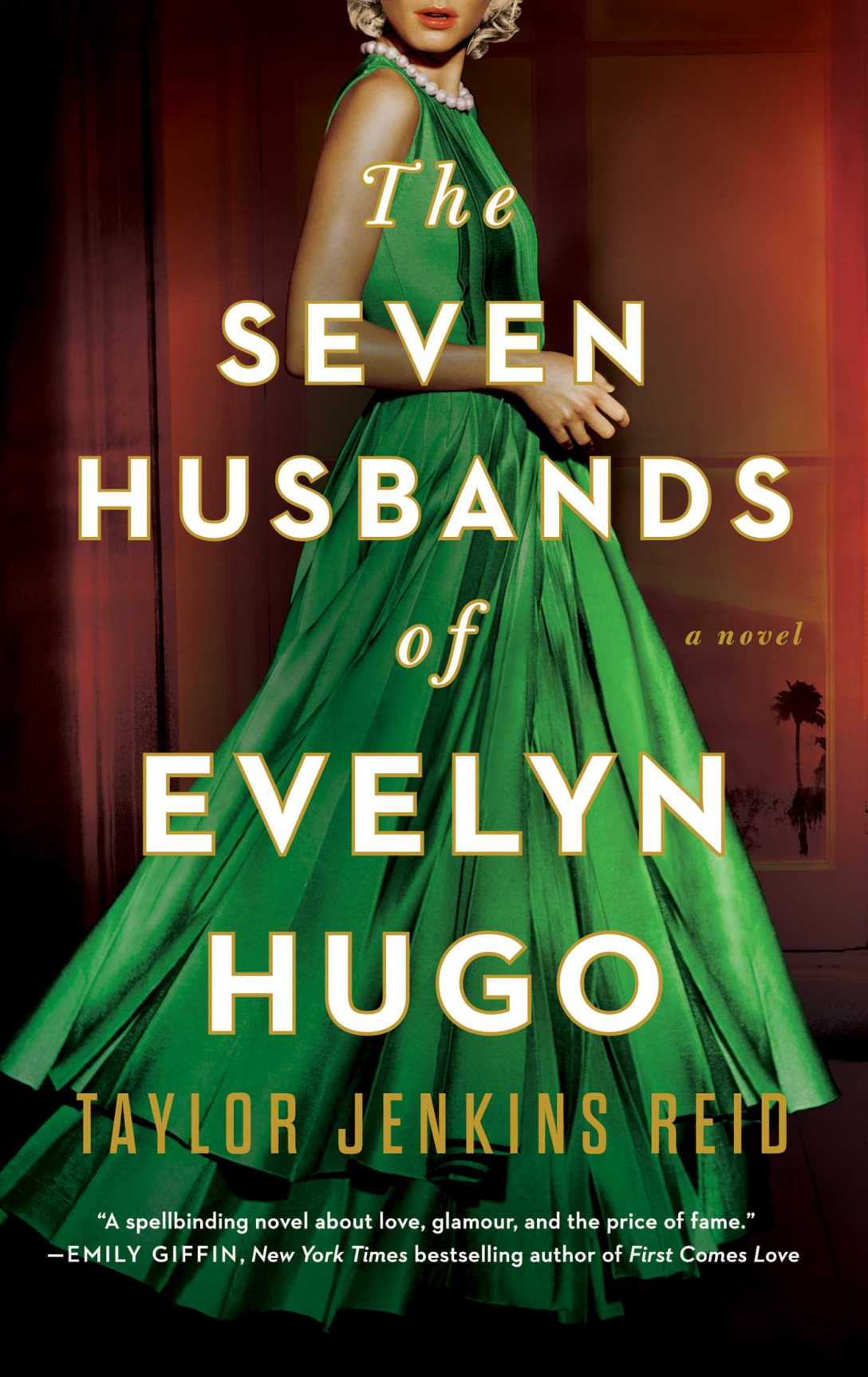
The Seven Husbands of Evelyn Hugo | Taylor Jenkins Reid

The Seven Husbands of Evelyn Hugo
by Taylor Jenkins Reid
Published by Atria Books (2017)
Rating: ***** 

This is a fast book. This does not mean it’s a short read – the page count is 388 (hardcopy) and 304 (softcopy). It’s just an incredibly fast-paced book. Before reading the book, I saw a friend get consumed in it, and she described the writing as “incredibly engaging”, amongst other adjectives. 300-odd pages later, I do not disagree one bit. This is, far and away, one of the best pieces of fiction writing I have read.

The plot, at first glance, doesn’t spark any emotional reaction. It’s about an ageing former starlet, Evelyn Hugo, who, after years of being reticent with the media, decides to grant Vivant magazine an interview – specifically in the context of some dresses she’s auctioning off for charity. Her only condition is that Monique Grant, a relative unknown, is the reporter who interviews her. A few pages later, and Hugo reveals her ulterior motive in inviting Grant to her home – to give Grant the exclusive tell-all and the rights to publish an authorized biography once Hugo dies. What transpires is this narration of Hugo’s life, leading up to the present day. That, however, is barely scratching the surface of it. Through the recount, we explore all the romantic relationships Hugo has had, the headlines she dominated during her heydey, and, in bursts, Monique’s present-day life. Throughout, there’s a sense of foreshadowing that the two women are connected somehow, a reveal which marks a fitting conclusion to the book.

I’m going to review this systematically since a lot of it is very, very fresh in my memory at the moment.

First, the characters. Since a large part of the narration happens in a setting that is the late 60’s/70’s, it’s pretty amazing that Reid weaves in such large amounts of representation into the book, in terms of the communities across the sexuality spectrum that she is able to describe. What’s also phenomenal is the way she introduces and describes her characters. Every character is relevant, and Hugo, the protagonist, manages to have meaningful interactions with each of them – which plays a huge role in plot development, but also in terms of your understanding of context. Moreover, the characters are not one-dimensional. It’s very difficult to use one adjective to describe them, for example. Each character is layered, and their contribution to Hugo’s life is well-explained, in terms of how they affect her thinking, and what her emotions are.

A special paragraph is needed to talk about the two protagonists, if you will. Evelyn and Monique, the two characters whose interactions shape the entire plot are really different from each other. There is a gap both in economic stature and in confidence – a distinction Reid draws within the first 50 pages itself. It is this distinction that enables both ladies to learn from each other. While Evelyn takes on more of a mentor role, it becomes clear that at latter parts of the book, especially towards its conclusion – there are things that she’s picked up from how Monique has responded to the tell-all. Monique’s growth through the story is phenomenal. If Evelyn is the one who is being reflective and assessing her life, Monique learns how to change her life – in terms of being able to put herself and her emotions before others. That emotional growth and maturity is well-traced, and not knee-jerk. Reid’s exposition of Monique’s life is measured and does not feel out of place – which deserves special praise.

Second, the treatment of sexuality, and representation.  I’ve already spoken about how diverse the characters are. What demands more attention, however, is how well she’s able to treat sexuality in the context she sets out. There are several things about an individual’s identity and sexuality that are incredibly confusing to people today – in terms of people exploring their sexualities, or identifying a particular way. It sparks off a lot of conversation – and this is despite our generation being lucky enough to have a lot of information and lesser prejudice than earlier. Reid is able to trace what it would have been like in the late 1900’s, and she’s able to do this in two parts.

The first, is pre-Stonewall, where the story charts the sexuality of several characters and their attempts to keep it secret and conform to the heteronormative expectation that society has for them. There’s also a specific discussion in this time period about bisexuality and it’s misunderstanding – something that stood out in this book. Without spoiling too much, it’s interesting to see that members of the homosexual community themselves didn’t fully understand what being bisexual meant. This is well documented today, but the fact that Reid chooses to give a voice to a bisexual character, engage with the social conflicts the character faces is worth a lot of praise. The second time period the book engages with sexuality in is post-Stonewall, which is a little more liberal, but involves conversations that lead to definitive decisions about coming out.

Finally, Reid deserves congratulations for her construction of family and friendship. If anything, there is a lot of pain in this book. There’s a lot of love, a lot of loss, a bunch of conflict around identity, and a lot of tabloid gossip. Through the recount, Hugo builds up what her friendships did to her, and then descends into a tale of her family. Her relationship with her daughter is so profound and the reactions so natural that you’re on edge to find out how the daughter will grow up. Her narration of “family” breaks away from a lot of traditional notions, and her detailing of the platonic/romantic divide in Hugo’s life leaves you wondering how much of romance today is a socially constructed expectation. Atleast, I was. It makes you ponder about how romantic relationships are treated in society as automatically being a step-up from a platonic one, and how untrue that premise is in reality. There’s one quote about intimacy that particularly stands out to me – in terms of how, more than anything, it’s the ability to be true with someone.

What is touching is her development of Monique’s arc and Monique’s family, and I think the relationship of mother and daughter there is another highlight. Monique’s mother is inserted into the book in just the right places, something I absolutely adored.

I would only dock points for the fact that the book is not slightly longer, for I think the ending (the last 30 pages) were extremely rushed. There is a certain power to the voices, the characters, and the description that Reid is able to weave, one that will linger in my memory for a while. All in all, a fantastic read, well worth the time and investment.

The White Castle | Orhan Pamuk

The White Castle
by Orhan Pamuk, translated by Victoria Holbrook
Published by Faber and Faber (2000)
Rating: **** 

This was my first Orhan Pamuk novel. Unsurprisingly, it’s his shortest novel, so it was a great place to begin reading all of his work. Pamuk is an author I have heard several literature geeks tell me about, but not someone I have been able to sit down and read. Pamuk, therefore, topped my list of authors for the year.

This is Pamuk’s first translated work. The translation here deserves credit, for it appears as if the novel is written in English itself – with details so vivid and flow so undisturbed. One wonders what the Turkish version of the book reads like.

The story begins as a straightforward first-person narrative about the misfortunes of a young Italian scholar who, en route from his native Venice to Naples sometime in the 17th century, is captured by Turkish pirates. Brought to Istanbul, he is imprisoned. Having convinced his captors that he was trained in Italy as a doctor, he finds himself called upon to heal everyone from fellow prisoners to a pasha. A man of high intelligence and common sense, he manages in most cases to effect a cure. Slowly, he wins the admiration of the pasha, who presents him as a slave to his friend, an eccentric scientist called only Hoja, a word, he tells us, meaning “master.”

The narrator appears wholly taken by the resemblance between himself and Hoja, a resemblance Hoja appears to ignore. Hoja, as master, commands the narrator to teach him everything he knows from the West – the science, the philosophy.

After a decade, Hoja and the narrator lay bare their past by writing the stories of their lives for each other to read. This exercise leads to both characters, who are entirely identical in appearance, who adopt the mannerisms of the other.

One day the bubonic plague overwhelms Istanbul. Eager to gain further power at court, Hoja conspires with his double to think of ways of reducing the risk of plague through the exercise of Western hygiene. Cats, for instance, are brought in to get rid of the rats that infest the city, although the sultan is told that these rats are really Satan in disguise. The scheme works, and the plague is banished – Hoja is elevated to Imperial Astrologer.

One of Hoja’s enduring obsessions has been the construction of an ultimate weapon — a “war engine” to rout the sultan’s enemies. The sultan now grants Hoja the necessary funds to pursue his hobbyhorse. Some years later, when a war between the Turks and the Poles erupts, Hoja’s expensive and ridiculous cannon is called into action to help in the assault on a glittering fortress in the Carpathian Mountains, the “white castle” of the book’s title. Alas, it can only fail. Hoja knows this, and he escapes from the battle into the fog rather than risk beheading by an irate sultan. In fact, Hoja leaves the sultan’s realm altogether and goes to Venice, to resume there the life of his Italian double, and his slave takes over Hoja’s life as a Turkish sage.

It is at this juncture, that Hoja introduces plot twists and brings into question the identity of the narrator. By the end of the book, you’re left uncertain about who the narrator actually was, and whether or not there were two characters at all.

In this act, lies Pamuk’s greatest triumph. The tale is really simple, the plot development rapid, and the prose, flowing. The twist at the end, however, is sufficient to keep you awake all night. It points at a fundamental question about human nature and human identities – the struggle of understanding oneself. By questioning who the narrator actually is, Pamuk makes you wonder: Why are you who you are? What shapes you? What is your motivation? What is your desire?

These existential questions may not be for all readers. They may also not arise to everyone who reads the book. For example, an alternate interpretation of the book would allow you to ask the question: Does slavery and captivity drive one insane?

Another alternate interpretation would make question the institution of religion and the concept of a value-system.

Whatever questions Pamuk leaves you with, it appears he does so without force. His words don’t point you to definitive answers, nor to mandatory questions. The ease of his narration, and the detail of the characters and dialogue make this an enjoyable, fast-paced read.

A star was docked for the ending. To me, it felt unfinished and incomplete. If this was a deliberate measure, it is one I am yet to fully appreciate. All I know is that I’m going to be reading a lot more of Pamuk, because I’m intrigued by the manner in which he weaves his tales.

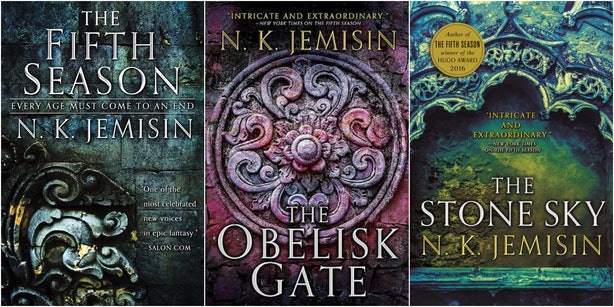
The Broken Earth Trilogy | N.K. Jemisin

The Fifth Season (Broken Earth #1)
by N.K. Jemisin
Published by Orbit (2015)
Rating: ***

The Obelisk Gate (Broken Earth #2)
by N.K. Jemisin
Published by Orbit (2016)
Rating: ****

The Stone Sky (Broken Earth #3)
by N.K. Jemisin
Published by Orbit (2017)
Rating: *****

This year I have several goals I’d like to accomplish with my book-reading. The first, of course, is a target number. What’s more important to me, however, is that I’m able to accomplish reading a diverse set of books over the course of the year. Diverse in terms of genre and in terms of authors I read. And I plan to do this by spending more time searching for books. Additionally, there’s this quest to read authors in full – so I can comment critically on their style of writing. The final desire I have is to be able to critically review books – from a literary perspective, I’d like to understand more about genres and offer more comments on writing.

A small step to that is writing this blog. This context is essential to understand why I read N.K. Jemisin. In 2017 November, I stumbled across Cixin Liu’s Three-Body Problem/Remembrance of Earth’s Past trilogy – which absolutely blew me away. While I was on the Internet, I discovered that Jemisin not only beat Liu’s final installment to a Hugo Award, but bagged herself three consecutive Hugos. That is not an easily accomplishable feat. I have found few Award-winning books to really resonate with me, so I thought I’d give it a shot. This is one of those series’, which for me, built-up over the course of the three books – which is reflected in my ratings of the trilogy.

How do you start to review a series that repeatedly explores the way the world ends?

The premise of the series is intriguing. The Broken Earth trilogy is set on a massive continent called the Stillness, in a far-future Earth wracked with periodic disasters known as Seasons. These Seasons aren’t just bad storms: they’re massive, apocalyptic events that last for generations, reshaping the world and its inhabitants. Those who survive huddle into Comms, protected communities that try to wait out the destruction, then crawl out and rebuild civilization before the next event. There are also remnants of an advanced civilization that persist throughout the destruction: giant, floating crystals called Obelisks.

Among the survivors of humanity are “orogenes,” individuals who can draw incredible magical power from reservoirs of the Earth. But while these orogenes serve a useful purpose for society, their training and treatment is brutal. They’re taken from their homes as children and brought to the Fulcrum, an order that trains and certifies them under the supervision of yet another order, known as the Guardians. When the Seasons come, they’re often singled out for death from Stills, their non-magical counterparts.

Good fantasy is always enjoyable to read because of the origins of thought and premises. In that regard, the series is fantastic. Jemisin is rare in her ability to understand the vastness and scalar nature of time when it comes to geology, but more crucially, is able to apply this understanding to create a sense of linear plot development. Her characters are well-crafted, and the shifting perspectives she provides for the central figures are refreshing and enjoyable, throughout all three books.

My independent assessment of the books, however, largely vary. I believe The Fifth Season was a lot of world-building, which is understandable for a trilogy, but did not create the level of plot engagement that I desired. There’s a lot in terms of plot-line convergence – in that Jemisin tries to reach conclusions to strands of thought that have begun, but in places, the book is agonizingly difficult to read – especially in its description of child abuse. It also made the protagonists difficult to like. If that was a deliberate choice, I think it affected a large part of my reading experience, which reflects in a lower rating.

The Obelisk Gate does a great job of balancing world-building and plot – which reflects in a 4-star rating. I think a large reason why I enjoyed it a little more was also because of the fact that I had context to why the world was so bizarre. If you’re someone who Wikipedia searches for plots and jumps in to the middle of the series, I think it might get slightly difficult to enjoy this one. What I especially enjoyed was the diversity in the cast – something that develops especially here. As a piece of feminist literature, and I use the tag deliberately, the book is able to explain oppression and power-dynamics a lot better than other fictional pieces. It gets you thinking. Being the middle-book, it does a fair enough job of creating longing for the conclusion. I docked points here because the writing and dialogue became boring in parts, dipping in their pace and their efficacy – and I say this as someone who enjoyed Lord of the Rings and other Tolkien works thoroughly.

The Stone Sky is downright incredible. It is the most fitting conclusion to the series, it’s difficult to imagine things ending any other way whatsoever. Jemisin’s writing hits peaks in it’s descriptiveness and it’s sense of apocalyptic society. It mirrors exactly what society is today. If the previous book got me thinking about power dynamics, this book got me thinking about internal prejudices a lot more. The dialogue is extremely powerful – and creates a sense of focus about the human experience and a pleasurable existence, in terms of having a family you love, and a support system that helps you overcome anything in the world. The prose is delightful and enjoyable. The characters make unexpected choices, but reasoned ones – and the reasoning is one that keeps you hooked.

It is, by far the best conclusion to a series I’ve read. I’d recommend the series on the whole – I think it’s worth reading. Fighting breaks in momentum with the first book might take time, but it’s a series that’ll keep you hooked once you start. Every Age must indeed come to an end.

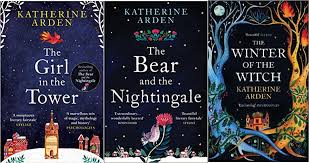
The Winternight Trilogy | Katherine Arden

The Bear and the Nightingale (Winternight #1)
by Katherine Arden
Published by Del Rey Books (2017)
Rating: *****

The Girl in the Tower (Winternight #2)
by Katherine Arden
Published by Del Rey Books (2017)
Rating: *****

The Winter of the Witch (Winternight #3)
by Katherine Arden
Published by Del Rey Books (2019)
Rating: *****

I’ve never posted about this trilogy in the past. Having read it last year, it felt only right that I wait for its conclusion before posting a comprehensive review – because as series’ progress, a lot of thoughts change. The Winter of the Witch, the final part to the trilogy released earlier this week. A few days later, I am pleased to say my thoughts about the series have not shifted since the first book, and my feelings remain unchanged. My personal ranking of the books would be:

  1. The Bear and the Nightingale
  2. The Winter of the Witch
  3. The Girl in the Tower

This fantasy (but-so-much more) series is set in an alternate medieval Russia, where history and myth (from Russian folktales) co-exist. It traces the growth of a young girl, Vasilisa (Vasya), who, having inherited a deep understanding of magic, is thrust with the responsibility of protecting her realm and her family from individuals who seek to destroy it, including from within.

While the first book focuses on her initial years and several tragic happenings (which shape her future decision-making), Vasya grows through the second book. Being ostracized by society, Vasya chooses to immerse herself in defiance of authorities that seek to straddle her powers and limit her choices. She conceals her gender and travels across Russia, befriending and earning the admiration of royalty in Moscow. The final book sees her defending the Russian Empire and owning her gender and the phrase “witch”.

That’s as succinct I can make it, but no amount of plot description is sufficient to detail the narratives that the books create for each character. Arden’s map of character progression is natural and predictable, yet, when events and choices are actually taking place, you find yourself overwhelmed with shock and overcome with emotion. The conclusion of the book is fitting, and perhaps an exemplar of Arden’s planning – it is one that can be foretold, yet alternative endings cannot be imagined.

The books are outwardly feminist, which is also an intriguing, careful choice that Arden makes. Russian folktales are difficult to adapt and retell, but she manages to weave in themes that will resonate with generations, and also sends across several messages relevant to global politics today. The protagonist, Vasya, is very, very badass, and her conduct of herself, especially through the second book, endears her to the reader rather quickly. While trilogies can get drab in the middle book, the pace is racy, and there is a continual sense of something building – keeping you hooked and waiting for the conclusion to the series.

Arden’s style of writing is narrative and vivid. Her attention to detail is exquisite, and it is evident that she has immersed herself in Russian history and culture prior to writing these tales. Her sense of time and setting are fantastic, and the atmospheric nature of her writing make these books an unputdownable read – especially in the winter. Her dialogue is short, but extremely effective, aiding plot progression, and creating meaningful interactions between her characters.

I’m glad also that the series was a trilogy and not more. While there are open-endings that will allow for the fanfiction world to concoct their own tales, Arden does a neat job of helping her protagonist reach a zenith – a fitting manner of conclusion. Anything more might have displaced that, and is a risk I’m grateful she did not take.

I’ve never found myself consumed by folktales as easily as I found myself invested in this series. While that demands me to doff my cap to Arden, I’m eager to see what history she chooses to retell next. The expectations are high.

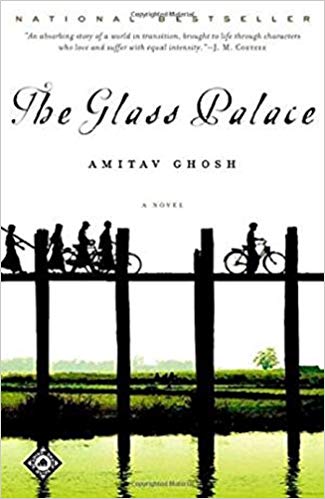
The Glass Palace | Amitav Ghosh

The Glass Palace
by Amitav Ghosh
Published by Random House Trade Paperbacks (2002)
Rating: ****

So many notable events occur around us on a daily basis. This makes the recording of news a difficult task. How do you select what is relevant and what is not, how do you choose what to report, and what to leave out? It’s also what makes the study and recording of History such a vast task. Human history has not been kind to historiographers. Nor has it been kind to authors of historical fiction. Ghosh, however, makes writing and living through a century an easy feat. In this accomplishment lies his greatest feat.

The Glass Palace is a fascinating account that takes place across borders. Politically, it reflects happenings in Burma and India around when Burma becomes colonized, and fascinatingly enough, the roots of an independence movement begin to develop in India. Economically, it looks at, and analyzes the impact of the discovery of teak and rubber as important trade items in Asia – the impact it has on individuals possessing these resources, and the broader societal structures relying on these individuals. On the whole, it’s perhaps the best novel I’ve read that focuses exclusively on the impact of colonialism on a lower-middle class society, incorporating the upper classes interactions with them.

The novel begins in Burma – focusing on a young kalaa (we later learn he is Indian) without a home, without parents. It introduces us to Rajkumar, and through the eyes of youth, describes the conduct of the Burmese Royals. Set in their ways, with several oddities. A short while later, Ghosh shifts perspective to focus on the Royals, and explains their history in brief. The shift in tone is evident, but not abrupt, and the pace of writing quickens through this passage to allow for a build-up to the exit of the Royals from India.

It is here that Rajkumar meets his Rani. An encounter with the Queen also leads to Rajkumar meeting Dolly – who he believes to be the most beautiful woman he has ever met. Their chance encounter appear to be the first of only two. They are separated, rather quickly, and the destruction the British Empire metes out is evident, rampant, and Rajkumar is also soon separated from his adoptive family, Ma Cho.

A significant accomplishment of Ghosh is how he interweaves the latter parts of Rajkumar’s and Dolly’s life. Living in completely different continents, Ghosh is able to use language effectively to sift through settings with ease. The vivid detail allows you to transition between what feels like two different novels with no real discomfort, and continuous plot progression.

The latter parts of the book highlight the inertia with Indian independence struggle at its initial phases, told through the relationship of a woman who connects Rajkumar and Dolly with the country. As a post-colonial read, the book is a fantastic account of history, told through an ever-expanding, but connected set of leading characters.

However, at points, events take place with an absurdness and staccato which is uncomfortable. People falling in love, people becoming best friends – these are events and feelings which develop over time, and Ghosh attempts to circumvent the process of describing his characters’ interactions by using a deadpan “X and Y became fast friends” in its absence. Understandably, a limitation of historical fiction is that a lot of words are spent on historical detail, but words are necessary at times to describe slowly developing feelings.

On the whole, an enjoyable read from an Indian-born author – a great start to 2019.

Caesar’s Last Breath | Sam Kean

Caesar’s Last Breath
by Sam Kean
Published by Little, Brown Group (2017)
Rating: ****

At it’s very core, this book is decidedly boring. There’s no reason for it to be interesting. It’s a book about the history of atmospheric gases. That basically means its stuff that’s literally, around us. Caesar’s Last Breath, may, in Shakespeare’s work, have produced some of the best lines of plays that we remember, but in reality, it probably was boring as well.

Safe to say, I was wrong about wondering why Rohan Joshi was reading this. The only reason I ended up procuring it was because the cover and the title amused me. By the end of the book, however, I was more amused by how shockingly little I know about the world. This book reinstated my belief in non-fiction writing and the importance of learning more by reading.

The argument Kean makes throughout this work is fascinating – that the air we breath today is made from what it was before we breathed it. That may sound confusing, but is perhaps the most apt way I can think of, to describe his argument. More broadly, the air you’re breathing in right now, could be the same air that Caesar breathed out when he last died.

This book ties together some of my favourite things: humour, history, and Science. Kean argues with tenacity and passion, and chronologically (for the most part) ties together an understanding of the air around us.

Caesar’s Last Breath ends not in the past, but in the future, with some dazzling speculation about what might go through the minds, not to mention the bodies, of the first space travelers to inhale the air of a planet beyond our solar system. It was a book I thoroughly enjoyed reading, and will recommend to everyone interested in Earth History in general.

The Subtle Art of Not Giving A F*ck: A Counterintuitive Approach to Living a Good Life | Mark Manson

The Subtle Art of Not Giving A F*ck: A Counterintuitive Approach to Living a Good Life
by Mark Manson
Published by HarperOne (2016)
Rating: ***

Self-help books are stereotyped in the market today. Get caught reading one, and you’re labelled as being depressive. Open up one, and you’ll find different versions/steps of arriving at the same conclusion: you are an incredible person, and you ought to be happy with what you’re born with. Rant against self-help books, and you’re labelled as someone who is nasty, who doesn’t understand that sometimes people need a pick-me-up, vote of confidence that puts the wind back beneath their wings, and the sails below their feet (or something to that effect).

Personally, I don’t read too many self-help books. I’ve dabbled in a few, and found them to be uninspiring. I do, however, see why it may appeal to some, and why certain lessons encountered, when spelt out, appear far more simplistic and easy to follow.

Manson’s book appealed to me initially because he seemed to be laying out his attitude to life in a manner comprehensible to the masses. The expletives were merely additional layers to make the book more relatable, it felt.

Take this: the different between indifference and not giving a hoot that you begin to prioritize what you care about. As a consequence, your attitude toward problems begins to become: What problem do I want to have? And that’s interesting. That’s an angle I appreciated – because as a victim of overthinking, I stress a fair bit about inconsequential things. It was a good way to get into the book, and Manson’s opening helps you decide fairly quickly if the book will suit you.

Manson then argues that in today’s society, the desire for more positive experience is itself a negative experience. In part, this is because of the manner in which our society celebrates “happiness”, but also because of how it trivializes the unique experience that happiness is.

And I found myself buying into that as well.

Manson has a unique manner of expression. Minus the expletives, his message is simple. You have limited time and limited resources. Accept this, and accept your other limitations. After accepting these, work on things you are desirous of working on. Don’t compromise on yourself. You’ll be happier as a result.

And, that, for me, is the sole reason the book is three stars.

The way in which the message is delivered does not detract from the archetypal self-help book trope. Further, I felt a little let down by the examples that were highlighted – particularly by the analogy of false memories and sexual harassment cases. I might be premature in saying this, but it is very possible that a reader will take nothing except the trivialization of a very real problem away from that example – something that is dangerous.

In contrast to a lot of self-help books, however, Manson delivers this message without anecdotal evidence. He relies on you realizing that the ones who appear carefree and confident are the happiest and most successful. That, in part, is his success, but to me, in part, is his failure.

Ultimately, I find contradictions in the message he puts out. Try to spend time on things you enjoy, with a caveat. Don’t get consumed by it such that it drives you every morning and takes control of how your day goes.

That’s an interesting perspective and one that I’d recommend reading – just for the style of Manson’s writing.


Modern Romance: An Investigation | Aziz Ansari and Dr. Eric Klinenberg

Modern Romance: An Investigation, 
by Aziz Ansari, Dr. Eric Klinenberg,
Published by Penguin Group (2015)
Rating: ***

Ansari has a way with words. He communicates thoughts in the simplest manner possible, without much regard for form – the substance of the idea is superior. It’s something that is noticeable on his stand-up specials, and even his hit show, Master of None. It’s what makes Ansari’s work so polarizing – with people on both sides of the like/hate spectrum. 

This book is no different.

Technology controls the way we lead our lives. From the news, to the weather, to human interaction – we spend more time on screens and electronic devices than we spend with people. This, naturally has an effect on the way relationships develop. That is the premise of Ansari’s quest in Modern Romance. 

A few caveats before we delve into observations. The book is not gut-wrenchingly humorous, as Ansari’s clips may well be. It does not, in any manner, make you laugh out loud at every second page. It is merely written by an individual with an incredible sense of humour – and therefore even mundane observations will get you to laugh because of recurring gags in the book itself. The book is also research-driven. It is something Ansari lays out categorically at the Preface, and therefore, the work does contain large references to previous papers, and transcripts from conversations with sociologists and leading relationship experts. If you aren’t interested in that kind of thing, this is not a book for you.

I was intrigued by the premise, which is the only reason I read this. 

The book both fulfilled my curiosity and disappointed me. 

My disappointment comes from the fact that I was not startled by anything the book presented. In fact, it felt very normal to read observations about how “iPhone users are twice as likely to sext than Android users are”, and how previous generations married and dated within a smaller cultural and geographical field. While the former is something I’ve observed as a result of my conversations with friends, the latter is something I have discussed with my parents. It is something that newspaper tabloids and sociologists have been writing about for a while now.

That theme runs true throughout the book. We discover that people find dating today exhausting, and that there are individuals who have different personalities over the phone and in person – all of which has been documented before. While there is no harm in presenting material available elsewhere, my grouse was the manner in which it was presented. It seemed mechanical and forced – lots of screenshots (which could be real, but also, could be doctored) to prove a point.

But, Ansari does do some things uniquely. And therefore, if you’re trying to understand relationship culture a little better, this book would be a great place to start.

First, of course, is the level of research. It is commendable that they relied on Reddit as a focus group. But it is also most representative because people have admitted that Reddit is perhaps the best place to be honest and anonymous on the internet.

Second, is the fact that Ansari chronicles his own relationship history through the book. There is a connecting, identifying element to the entire narrative – one that you miss out on while reading non-fiction. It makes you invested, to say the least.

Finally, the book provides really good perspective on dating in other countries. In India, we’re a real mixed blend of liberal people and conservative individuals – tilted toward the conservatism. Reading about practices in Qatar, Japan, France and Argentina, just opens up your mind to possibilities – and how much society influences the way you think about your own relationships. 

It is intriguing and all in all, was a quick read.