2019: Forty-Five

So I was in the Scoring Room today and discovered that one of the juniors on campus who reads this blog felt very duped when I posted clickbait titles or something of the sort on twitter, or even marketed the fact that I had uploaded something new – but in reality, wrote only 10-15 words. I chuckled quite hard when I found out, for a variety of reasons. First, it felt good to know that I had become someone who had the ability to dupe people: albeit at a very small scale, and all the while being behind a computer. (As I typed this, I daydreamed a court scene where I was charged for fraud and the prosecutor attempted to use my previous sentence as evidence against me – so I’d like to make it unambiguously clear, this is humour.)

Second, I laughed because it was heartening to see that people stuck with this blog – from it’s very inception, I’ve seen that a few people read and talk to me about what I post. Considering that a majority of my viewership comes from my family, I don’t pay much attention to the stats for this blog. It’s just a thing I do. But to know someone is consistently reading is a delight: even though I might be duping them.

Third, it’s funny that people actually click on clickbait. It’s weird, but I’m wondering how people get attracted toward something that looks like a click-baity title. I’m a victim of the same process, and I find myself reading articles with catchy headings but with mediocre content. While I know that’s a skill, and several people do earn money for helping with marketing and clickbait, the science/psychoanalysis behind it amazes me. SSRN has a great collection of papers that are worth reading on this topic, so if you’re interested, you’ve got a starting point.

But to the junior and the people who I have duped by writing 10 words and making you click on a post to read 10 words. I shall write more, I promise. And if I dupe you in the future successfully, please accept a thousand apologies.
2019: Forty-Four

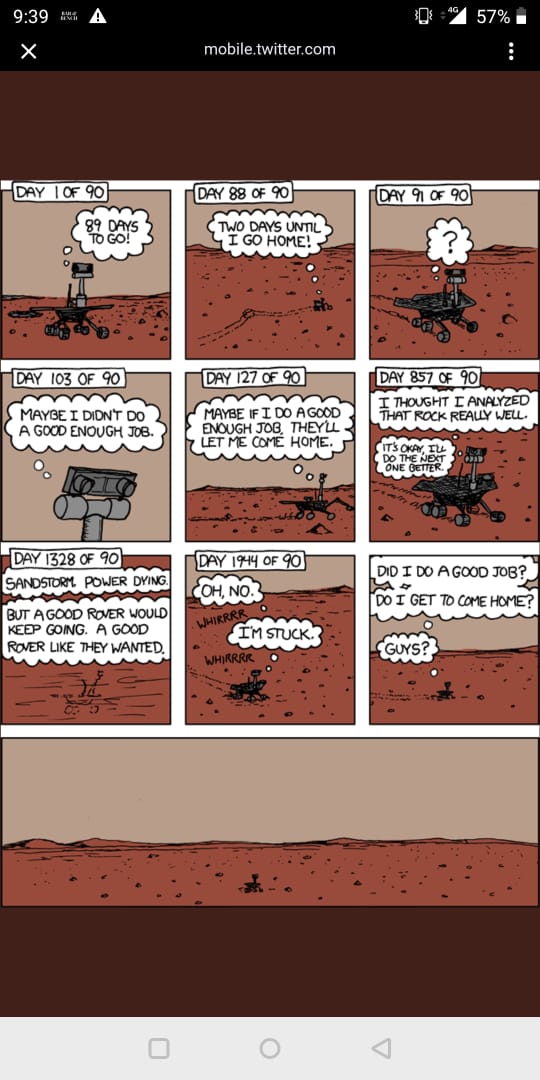
Some sad news today. The Mars Opportunity Rover has been declared dead. I never knew I’d be so affected by this news, and then I saw this comic:

WhatsApp Image 2019-02-14 at 15.55.37.jpeg

I do hope they bring the Rover back one day. Somehow. Maybe then we can all visit it. It’ll also mean that we wouldn’t have left

In other news, one of our annual moot court competitions has begun, so campus is really lively at the moment. Which is always great fun. It’s also got me thinking a lot about how our campus manages to string together events one after another. Especially around February, which is the most active time on campus. People/committees just churn out events one after another. There’s so much happening on campus that at this point, there are 3 things I have the option of doing: attending a lecture on Aadhar, participating in helping with this moot, and attending a lecture on education. It’s pretty wild. I’m pretty lucky to be here.

The other really great thing about moots you organize? Wearing nice formals. Formal pants are underrated pieces of clothing. They’re so comfortable, wow. Can’t wait to wear all my formal things.

And eat all the good food.

2019: Forty-Three

I’ve noticed over the past few days that I’ve been struggling to engage in conversation with people over the phone/in person. For example, speaking to my parents has become super transactional – something I’m not too fond of. And they can tell this too. Recently they told me my voice sounded low over the phone. It surprised me that they could pick up on it, and I’m not entirely sure what caused it: because truth be told, everything is fine only.

But I guess I haven’t been telling them about my day in as much detail as I did back in first-year, or, that I don’t display the same level of enthusiasm about University as I did back then. That’s definitely a causative factor, I think.

And it’s something that deserves some level of correction, in my view. When I came down here in first year, I saw enough cynics in Law School for me to actively want to avoid becoming one myself. I don’t think that transformation is complete as yet: I’m not a cynic, I still love University. But, I do criticize it a lot – especially things like classes and the food, my two biggest complaints. And all of that criticism, all of that hate, has sucked a lot out of the enthusiasm out of me.

Maybe it’s actually time to revive a lot of that.

2019: Forty-One

It’s interesting to me that we’ve got more accessibility to a language that originates from our land in a foreign nation, than we do in the Courts of our own country. There’s a lot to think about in terms of making Courts more accessible, but perhaps this is a thought worth prioritizing:

https://timesofindia.indiatimes.com/world/middle-east/abu-dhabi-includes-hindi-as-third-official-court-language/articleshow/67925375.cms?utm_source=facebook.com&utm_medium=social&utm_campaign=TOI&utm_content=om-bm&fbclid=IwAR3z_MqjJiDdSBhybUQx4JVjzdhRPvmpLQYW40vKfQEpDhoVrPzqznlw180

2019: Thirty-Eight

Reading has the power to transform your life. It gives you the ability to live through another person’s lens for a few hours, or days, or weeks. It gives you perspective. It teaches you lessons, and gives you the opportunity to self-reflect. How would you behave in a similar circumstance? What consequences does your behaviour have? All of these questions and more, are questions I’ve been able to embrace in the past week – largely because I’ve been reading fiction.

Now, I was one of those kids that came to Law school and was taken aback by how much I didn’t know about the real world. My corrective mechanism to this was to read non-fiction: as much as I could. I tried doing that through 2017, and then through 2018 – where I started off with wanting to read one fiction and one non-fiction book a day. Non-fiction consumed my life in a way not much has. I’d be reading newspapers and longform posts whenever I was free, and turn over to a hardcopy of a non-fiction book when I was back in my room. I’d discuss largely non-fiction things with my friends – happenings from the real world, which I could analyze tangibly. I’m grateful for that, because I felt like I wasn’t as uninformed as I was earlier. I also dislike not knowing things, so reading non-fiction taught me a lot, which I enjoyed. But reading non-fiction can be drudgingly slow to get through, and tougher to remember. Bad non-fiction can be horrifying, because of this factual narration. The worst part is that it’s all real, there’s literally no escape from the truth. Even where you DNF a book, you’ll end up feeling like there’s something real you’ve left behind.

Which is what makes me so happy about reading fiction – a joy I’ve rediscovered. Good fiction is fast-paced, page-turning, and immersive. Bad fiction is slow, dull, with a lack of plot and narrative arcs to keep you engaged. In either case, fiction is a product of the human mind, and human creativity. It has the ability to get you really thinking about things you see in the world. Fiction is often a “reflection” of the world – it’s not necessarily the real world itself, which is something fabulous. You can adopt course corrective measures because you don’t enjoy how the world is when you read a piece of fiction. You can change your own behaviour. You can form opinions that have an impact.

Or, you can just enjoy a book without any real-world consequences, and get lost in a world that isn’t your own. That’s a liberating feeling I can’t get anywhere else, except between pages.

I’ve been fortunate to experience that in the last week more than ever. Class has become horrifyingly slow for me to sit through, so every night, I try to pick out a fast-paced book for me to read in case I need the time to go by. And boy, oh boy, does it.

The morality of my actions confuse me – should I be paying attention? But the morality of my decision to read means I can attend classes without feeling guilt – for I have been productive, and I have enjoyed my classes thoroughly. Sometimes the ends, they justify the means. I guess.


2019: Thirty-Seven

My campus has the ability to amaze me with the talent it seems to have on offer. For all the thoughts I have about how people here are the same – and have very overlapping goals after law school, I often realize that’s merely one facet of things. This is especially true at fests and cultural events that the University hosts. People’s ability to take charge of things and make this place smile is beautiful. People’s creativity is mind-blowing.

For example, very few would think about hosting a board games night during a Sports Fest. But our University has a rich tradition of board games being available at the night mess, and a lot of fights have ensued as a consequence of them. So why not, right? But that’s only one part of the story. The second half is the ability to make the night mess come to life by decorating it, putting up paintings and decor, giving a name that resonated with the masses and attracted a crowd, have live music by the Music Club – all these good things which make the event unique and memorable. All these things need effort, and the people who put the effort in are the people I admire – because it takes a lot to work in a team surrounded by individuals who have different talents and get them focused on a single goal.

That’s been my brain for the day.

2019: Thirty-Six

It seems pretty routine for me to think about how “busy” I’m becoming as the semester wears on and time passes. February is the busiest time in University, by a country mile. It’s when the most number of events take place – one after the other. Week after week. I enjoy being involved in all of them, but this year I’ve found another committee to keep me busy while I do bits and pieces of events work and help out where I can. Now, I’m not on the Core of any event that’s happening this semester, so I can’t relate to the stress they must be going through. For me, all these events happening on campus are an excellent opportunity to enjoy good food, one week after another. Especially because there’s always going to be a lot of food trucks who come by. I’m also looking forward to meet some friends who are coming down for these events – which should be super enjoyable.

But having all of this has made me tired. I used the weekend to try recuperating but I woke up on Monday morning feeling sleepy. I can now automatically switch off and zone out of class, falling asleep in an instant. I think that’s a useful skill if I’m trying to make up for lost sleep – which I have in the past. I’d really like to wake up one morning feeling well-rested though.

The other side effect of all of this has been a lot of procrastination. It’s procrastination which hasn’t affected individual tasks and their timelines – most responsiblity I take on is responsibility that can wait, responsibility that has deadlines which aren’t looming on the horizon. None of them overlap either. Which makes them easier to fulfil. But procrastinating them means I find myself waiting till the last moment to even start tasks sometimes – which is getting frustrating.

So I’ve set tonight as a night to catch up on pending work, because otherwise I’ll go down a blackhole of YouTube autoplay videos – which to me, is the point of no return.

2019: Thirty-Five

Talking to new people is so fascinating. I’m pretty active on messenger applications and really try hard to stay in touch with friends and everything, but sometimes you can get a new contact on your phone – either via a group you’re in, or maybe even an event you’re participating in or helping out with. You’ll even receive personal messages from this unknown number – a “come help out”, or “Hey! Can I send you my attendance exemptions form?”, and naturally, you’re likely to answer only the question you’re asked – and not much more.

But what if you don’t know someone and they send you a message to make sure their friend is hanging with the right kind of crowd from far away, just out of care. And that sparks off conversation which continues on the daily, through periods where you’re each busy and replies are delayed, but somehow, conversation goes on, links are shared – and you learn more about them.

And then you finally get to speak to them – and conversation goes on the way it always has. But all those chats and layers of context finally attach themselves to a voice.

What I find fascinating is that this is how the human brain works – it attaches identity and layers of context to a voice (that you learn how to recognize), and also to an appearance. It attaches emotion to people and memory to conversation.

If all of this isn’t the human experience, I’m not sure what is.

2019: Thirty-Four

The premise with which arguments start is something I find quite fascinating. Most arguments, for example, begin on contradictions which rely on first principles – a concept we learn while debating at University. Identifying these first principles is a great way to see where two differing sides clash.

But when you read a judgment, or some form of a final decision: whether that’s a review, or an opinion piece – all of these start off with premises. Assumptions they make to be fundamentally correct. Over the past few weeks, I’ve been thinking a lot about how these premises also need questioning sometimes, and how sometimes, decision-makers fail to lay out these premises clearly, or fail to offer justification about how their premise is true.

This reading list is a great example: https://www.epw.in/engage/article/why-aadhaar-judgment-flawed-reading-list?0=ip_login_no_cache%3D48e70aea2b0036df81d5e6821b11e4f5