2019: Forty-Four

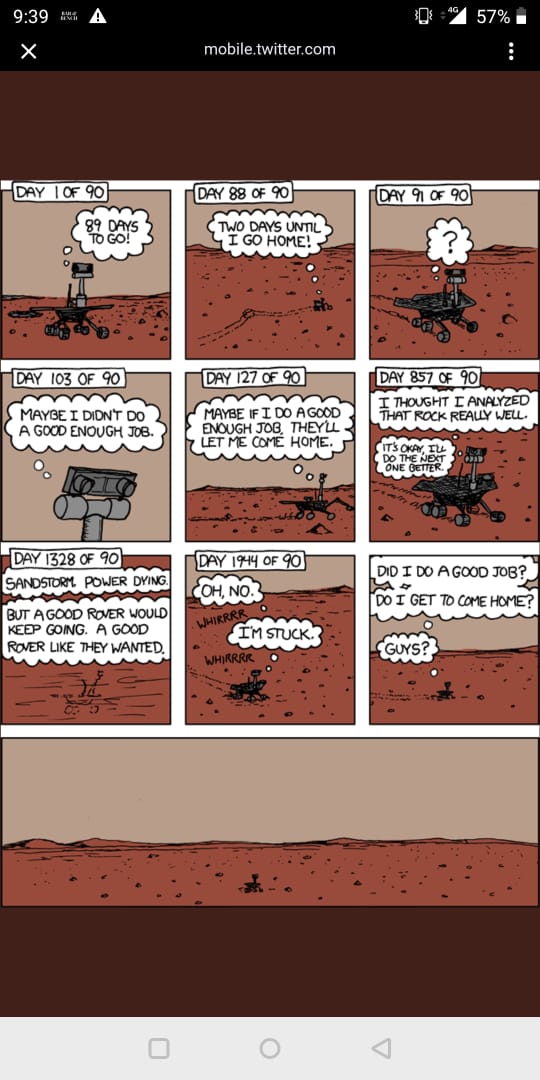
Some sad news today. The Mars Opportunity Rover has been declared dead. I never knew I’d be so affected by this news, and then I saw this comic:

WhatsApp Image 2019-02-14 at 15.55.37.jpeg

I do hope they bring the Rover back one day. Somehow. Maybe then we can all visit it. It’ll also mean that we wouldn’t have left

In other news, one of our annual moot court competitions has begun, so campus is really lively at the moment. Which is always great fun. It’s also got me thinking a lot about how our campus manages to string together events one after another. Especially around February, which is the most active time on campus. People/committees just churn out events one after another. There’s so much happening on campus that at this point, there are 3 things I have the option of doing: attending a lecture on Aadhar, participating in helping with this moot, and attending a lecture on education. It’s pretty wild. I’m pretty lucky to be here.

The other really great thing about moots you organize? Wearing nice formals. Formal pants are underrated pieces of clothing. They’re so comfortable, wow. Can’t wait to wear all my formal things.

And eat all the good food.

2019: Forty-Three

I’ve noticed over the past few days that I’ve been struggling to engage in conversation with people over the phone/in person. For example, speaking to my parents has become super transactional – something I’m not too fond of. And they can tell this too. Recently they told me my voice sounded low over the phone. It surprised me that they could pick up on it, and I’m not entirely sure what caused it: because truth be told, everything is fine only.

But I guess I haven’t been telling them about my day in as much detail as I did back in first-year, or, that I don’t display the same level of enthusiasm about University as I did back then. That’s definitely a causative factor, I think.

And it’s something that deserves some level of correction, in my view. When I came down here in first year, I saw enough cynics in Law School for me to actively want to avoid becoming one myself. I don’t think that transformation is complete as yet: I’m not a cynic, I still love University. But, I do criticize it a lot – especially things like classes and the food, my two biggest complaints. And all of that criticism, all of that hate, has sucked a lot out of the enthusiasm out of me.

Maybe it’s actually time to revive a lot of that.

2019: Forty-One

It’s interesting to me that we’ve got more accessibility to a language that originates from our land in a foreign nation, than we do in the Courts of our own country. There’s a lot to think about in terms of making Courts more accessible, but perhaps this is a thought worth prioritizing:

https://timesofindia.indiatimes.com/world/middle-east/abu-dhabi-includes-hindi-as-third-official-court-language/articleshow/67925375.cms?utm_source=facebook.com&utm_medium=social&utm_campaign=TOI&utm_content=om-bm&fbclid=IwAR3z_MqjJiDdSBhybUQx4JVjzdhRPvmpLQYW40vKfQEpDhoVrPzqznlw180

Skyward (Skyward #1) | Brandon Sanderson

Skyward (Skyward #1)
by Brandon Sanderson
Published by Gollancz (2018)
Rating: ***  

Throughout this book, I felt like I was reading Artemis, by Andy Weir. I try to refrain from making comparatives, but the premise of both plots are extremely similar: a female protagonist attempting to disprove society, outer space, and an identity conflict which pervades across the protagonist’s relationship with other characters in the book. I left the book thinking it merited a 4-star rating, but the more I thought about the ending, the more my feelings, and consequently, my rating dipped. To be fair, I think this book is truly an exemplar of 3.5-star writing. I’ll attempt to justify my conflicting emotions throughout this review. A couple of things I’d like to clarify: this book isn’t like any other Sanderson material. If you’re coming into this book expecting something similar to Mistborn – it isn’t there. You’d rather adjudicate this book on its own merit.

Spensa has always longed to be a pilot like her father –  even when he flees in the middle of battle and is shot down by his own side in punishment for cowardice. Spensa is one of the descendants of a wrecked space fleet who found a precarious refuge in the caverns of a graveyard of a planet while an unknown alien species launches constant attacks, trying to destroy what civilization humanity has managed to recreate. Spensa and her family have to live under her father’s dishonorable reputation, even though Spensa is certain that he wasn’t a coward and that there has to be more to the story. Getting into flight school will be hard enough, but graduating will be even harder — many cadets and pilots don’t survive their first encounters with the enemy. In a predictable conclusion, Spensa participates in several heroic acts in an epic battle sequence at the end.

Let’s deal with the positives first, for I do think the book has plenty.

The characters are incredible. There’s a depth to each one of the individuals Sanderson creates, and each of them help with plot development greatly. What I admire about Sanderson’s writing is his ability to create character arcs for every one of his characters, without it feeling forced onto the reader. Sanderson cleverly masks each individual’s history: whether Cobb’s, Ironside’s, Gram-Gram’s, and even Jerkface’s, into their interaction with Spensa. This allows the reader greater understanding of each character’s motivations and weaknesses, with an easy comparison to Spensa’s own. Another result of doing this is that the focus never wavers from Spensa herself, which allows Sanderson to develop her to the fullest in this book.

Another component of the book I enjoyed greatly was the conflict Sanderson creates in the atmosphere. There are numerous levels to this, which deserves some appreciation. The first is of course, the conflict between the Krell and the DDF, which plays out in a very strategic set of wars. The second, is the conflict between Spensa and everyone around her – who doesn’t believe she is worthy of flying: either because of the fact that her father was a coward, or because she possesses a “defect”. Sanderson attempts to weave the two together in the conclusion – which I don’t particularly enjoy, but we’ll get to that later. The last, is the conflict Sensa senses in herself. Continuously driven by her fear of being labeled a “coward”, she resists using the term, and finds herself confused, at several junctures about whether her actions smell of fear, or of “cowardice”. This emotional conflict is a marvelous layer to the plot, which I think drove the narrative in this book.

Finally, Sanderson seems to have done some research before writing. I think the space opera elements of Skyward, in terms of the machinery and weaponry involved, is not any that’s present in literature today. The schematic drawings provided in-book were super fun to peruse through (although I feel like that’s something the publishing house added), the detailing was excellent. However, at times it felt like Sanderson got trapped in a pit of overusing the phrase “g-force” to describe any sensation Spensa felt in her Poco jet. The level of research I think tells most when it comes to M-Bot, which is a figment of his imagination, but I think, the funniest character in the book, with the wittiest one-liners. M-Bot’s technological prowess is phenomenal. Considering this is the first book in the series, I’m really hoping for more of M-Bot in later books to come. And more Doomslug.

Now, the negatives.

See, for all the joy Spensa the character gave me, I didn’t really understand several parts of her world. A conversation with a friend revealed that we were both equally clueless about how her world functions. To me, this is a big deviation from Artemis, which despite it’s own flaws, did a phenomenal job of world building. You almost had no questions to ask. Here, you’re left wondering how exactly/where exactly that world fits into our understanding of the galaxy, which I think is a bit problematic. Moreover, the lack of world building is an issue because this is the first book in the series. It feels like Sanderson lacked clarity about what he envisaged the world to be like. The first book, for me, is really important to gauge whether or not I’m going to be hooked to the series. Good first-books balance plot development and world-building really well, and Sanderson is capable of this: he shows us that through The Final Empire. This, however, falls flat in comparison. As a consequence, it feels like descriptions of the world in future books in the series are afterthoughts/additions to help plot flow better.

The second thing I disliked was the ending. I’m still actually quite confused about what actually transpired – because while I understood the action taking place on-ground/in-space, I didn’t understand the layering that Sanderson had done – in terms of Spensa’s final interaction with her mother/grandmother. It left a lot to be explained – something I’m hoping comes out in the next few books. I’m quite certain that it’s meant to be vague, to allow for development later in the series. The level of vagueness though, was a little too much.

To conclude: absolutely thrilling, fast-paced book. Great plot, amazing characters. Vague attempt to be profound at the end, unclear world.

You see my confusion? This is a 3.5 dilemma situation.

A friend of mine offered some good insight. I think this, unlike Mistborn, is meant for the younger side of the YA spectrum audience. An enjoyable read, but one I’m okay skipping out on. Which is sad, because Space stuff is usually right up my alley.

2019: Thirty-Eight

Reading has the power to transform your life. It gives you the ability to live through another person’s lens for a few hours, or days, or weeks. It gives you perspective. It teaches you lessons, and gives you the opportunity to self-reflect. How would you behave in a similar circumstance? What consequences does your behaviour have? All of these questions and more, are questions I’ve been able to embrace in the past week – largely because I’ve been reading fiction.

Now, I was one of those kids that came to Law school and was taken aback by how much I didn’t know about the real world. My corrective mechanism to this was to read non-fiction: as much as I could. I tried doing that through 2017, and then through 2018 – where I started off with wanting to read one fiction and one non-fiction book a day. Non-fiction consumed my life in a way not much has. I’d be reading newspapers and longform posts whenever I was free, and turn over to a hardcopy of a non-fiction book when I was back in my room. I’d discuss largely non-fiction things with my friends – happenings from the real world, which I could analyze tangibly. I’m grateful for that, because I felt like I wasn’t as uninformed as I was earlier. I also dislike not knowing things, so reading non-fiction taught me a lot, which I enjoyed. But reading non-fiction can be drudgingly slow to get through, and tougher to remember. Bad non-fiction can be horrifying, because of this factual narration. The worst part is that it’s all real, there’s literally no escape from the truth. Even where you DNF a book, you’ll end up feeling like there’s something real you’ve left behind.

Which is what makes me so happy about reading fiction – a joy I’ve rediscovered. Good fiction is fast-paced, page-turning, and immersive. Bad fiction is slow, dull, with a lack of plot and narrative arcs to keep you engaged. In either case, fiction is a product of the human mind, and human creativity. It has the ability to get you really thinking about things you see in the world. Fiction is often a “reflection” of the world – it’s not necessarily the real world itself, which is something fabulous. You can adopt course corrective measures because you don’t enjoy how the world is when you read a piece of fiction. You can change your own behaviour. You can form opinions that have an impact.

Or, you can just enjoy a book without any real-world consequences, and get lost in a world that isn’t your own. That’s a liberating feeling I can’t get anywhere else, except between pages.

I’ve been fortunate to experience that in the last week more than ever. Class has become horrifyingly slow for me to sit through, so every night, I try to pick out a fast-paced book for me to read in case I need the time to go by. And boy, oh boy, does it.

The morality of my actions confuse me – should I be paying attention? But the morality of my decision to read means I can attend classes without feeling guilt – for I have been productive, and I have enjoyed my classes thoroughly. Sometimes the ends, they justify the means. I guess.


2019: Thirty-Seven

My campus has the ability to amaze me with the talent it seems to have on offer. For all the thoughts I have about how people here are the same – and have very overlapping goals after law school, I often realize that’s merely one facet of things. This is especially true at fests and cultural events that the University hosts. People’s ability to take charge of things and make this place smile is beautiful. People’s creativity is mind-blowing.

For example, very few would think about hosting a board games night during a Sports Fest. But our University has a rich tradition of board games being available at the night mess, and a lot of fights have ensued as a consequence of them. So why not, right? But that’s only one part of the story. The second half is the ability to make the night mess come to life by decorating it, putting up paintings and decor, giving a name that resonated with the masses and attracted a crowd, have live music by the Music Club – all these good things which make the event unique and memorable. All these things need effort, and the people who put the effort in are the people I admire – because it takes a lot to work in a team surrounded by individuals who have different talents and get them focused on a single goal.

That’s been my brain for the day.

The Astonishing Colour of After | Emily X.R. Pan

The Astonishing Colour of After,
by Emily X.R. Pan
Published by Little, Brown Books (2018)
Rating: ***** 

Don’t let the number of chapters or pages in this book fool you. It’s a fast-read. Page-turning, emotionally engaging, and gripping, you’ll find yourself wondering where the time went as you finish. If you’re looking to get out of a reading slump, and fall in love with good writing again, this is a great starting point.

The story follows Leigh Sanders, a half-Taiwanese, half-American girl, as she struggles to cope with loss. On the same day she kisses the boy she’s pined over for years, her mother, Dory, commits suicide. At first the grief is overwhelming. She feels trapped in her childhood home with her distant father and the bloodstain marking her mother’s demise haunting her thoughts. Then, the night before the funeral, Leigh is roused from her nightmares by a huge crimson bird calling her name. She knows immediately the bird is her mother, the whys and hows brushed aside in the face a daughter’s longing for her mom. The plot then takes us to Leigh’s discovery of family she never knew, and her journey of “moving on” from an event she struggles to talk about or understand. All the while, her desperation to make contact with her mother once more drives her between the fantastical and the real, making this a journey unlike any other.

There’s a lot of plot depth to the book, which deserves a bit of analysis.

The first is the theme of identity. Leigh’s identity is clearly complex – she’s half-Asian and half-white, and Pan brings this out by describing how society views her. The Americans call her “exotic”, while the Taiwanese call her “hunxie”/”mixed blood”. Through these individual instances, Pan is able to portray the otherization that mixed-race people usually feel, without a strong connection to either cultural group. This conflict is also given a new layer by the presence of Axel, who is half-Filipino, and half-Puerto Rican. Their friendship and understanding, and their journey of family discovery points to the fact that both characters find comfort in each other – because there’s no other place they fit in.

The second, is how Pan tackles mental health. Now, the conversation on mental health has improved drastically – people are now more comfortable to discuss it in society, but Asian countries are notorious for their inability to accept diagnosed mental health illnesses as being real. There’s an ignorance in Asian society, which Pan is able to describe very realistically. Leigh struggles to use the word “depression”, unable to admit to herself that her mother suffers from the same. The suicide that takes place is without a note, and is committed by OD-ing on antidepressants, and several episodes are described in great detail in the novel. Pan is able to explain depression as it really is – difficult to understand, tough to explain and articulate. The biggest thing Pan achieves is that she doesn’t display “continuous sadness” as equal to depression, something I admired after I finished the book. Another achievement lies in steering away from psychonalysis or patient-blaming/patient-shaming. There’s no sugarcoating of the condition, or of death. It’s difficult, but the truth of depression is just that, and Pan’s judicious use of words deserves credit.

The third is art. Now, I wasn’t sure whether to highlight this as a theme within the book, but there’s layers to this which deserves some amount of description. Leigh, Axel, Caro, and Dory, are all artists. Each, unique, and each, with a different connection to their art. Leigh’s father, is an American academic. Stereotypes lead us to believe that strict Asian parents undermine art, viewing it as being a gateway to University, or a skill that deserves mastering purely for the purpose of mastery. What Pan does is flip the stereotype, by showing a large majority of Leigh’s social circle being pleased with art as a career choice, while Leigh’s father attempts to track her to become more “serious” and asks her questions about her future. That narrative was one I found incredibly interesting to read. It creates a tension in the familial relationship that persists throughout the novel, right until the very end. Why I believe art is a theme is also because of how well Pan is able to use colour throughout the entire book. Just like shades on a palette, I learnt about emotions I didn’t know I could ever feel – and the correlation between colour and emotion will strike a chord with any reader. It’s use as a device for me was not distracting, and I enjoyed it thoroughly.

Finally, the fantastic imagery and fantasy elements deserve a lot of praise. The plot is very tight, and the fantasy weaves very smoothly with plot developments taking place in reality. Pan’s conclusion hits the heart hard, describing the truth of experience and memory unlike anyone else I’ve read. Reading the book reminded me a lot of the Disney movie Coco. It incited similar emotions in me, I guess.

My only qualm with the book was the romantic side of the story. Romance sells, but in parts, the romantic uneasiness felt out of place. The conclusion to the romantic arc within the book was predictable and well built-up. It’s pace at the end, however, was rushed, and artificial. No natural love story progresses like that. There’s a lot more conversation – one that I would have loved to see the protagonists engage in. The book leaves a few things unsaid, which might annoy some readers.

All in all, a must-read, quick-read. Will make you feel things. Would recommend.

2019: Thirty-Six

It seems pretty routine for me to think about how “busy” I’m becoming as the semester wears on and time passes. February is the busiest time in University, by a country mile. It’s when the most number of events take place – one after the other. Week after week. I enjoy being involved in all of them, but this year I’ve found another committee to keep me busy while I do bits and pieces of events work and help out where I can. Now, I’m not on the Core of any event that’s happening this semester, so I can’t relate to the stress they must be going through. For me, all these events happening on campus are an excellent opportunity to enjoy good food, one week after another. Especially because there’s always going to be a lot of food trucks who come by. I’m also looking forward to meet some friends who are coming down for these events – which should be super enjoyable.

But having all of this has made me tired. I used the weekend to try recuperating but I woke up on Monday morning feeling sleepy. I can now automatically switch off and zone out of class, falling asleep in an instant. I think that’s a useful skill if I’m trying to make up for lost sleep – which I have in the past. I’d really like to wake up one morning feeling well-rested though.

The other side effect of all of this has been a lot of procrastination. It’s procrastination which hasn’t affected individual tasks and their timelines – most responsiblity I take on is responsibility that can wait, responsibility that has deadlines which aren’t looming on the horizon. None of them overlap either. Which makes them easier to fulfil. But procrastinating them means I find myself waiting till the last moment to even start tasks sometimes – which is getting frustrating.

So I’ve set tonight as a night to catch up on pending work, because otherwise I’ll go down a blackhole of YouTube autoplay videos – which to me, is the point of no return.

2019: Thirty-Five

Talking to new people is so fascinating. I’m pretty active on messenger applications and really try hard to stay in touch with friends and everything, but sometimes you can get a new contact on your phone – either via a group you’re in, or maybe even an event you’re participating in or helping out with. You’ll even receive personal messages from this unknown number – a “come help out”, or “Hey! Can I send you my attendance exemptions form?”, and naturally, you’re likely to answer only the question you’re asked – and not much more.

But what if you don’t know someone and they send you a message to make sure their friend is hanging with the right kind of crowd from far away, just out of care. And that sparks off conversation which continues on the daily, through periods where you’re each busy and replies are delayed, but somehow, conversation goes on, links are shared – and you learn more about them.

And then you finally get to speak to them – and conversation goes on the way it always has. But all those chats and layers of context finally attach themselves to a voice.

What I find fascinating is that this is how the human brain works – it attaches identity and layers of context to a voice (that you learn how to recognize), and also to an appearance. It attaches emotion to people and memory to conversation.

If all of this isn’t the human experience, I’m not sure what is.